
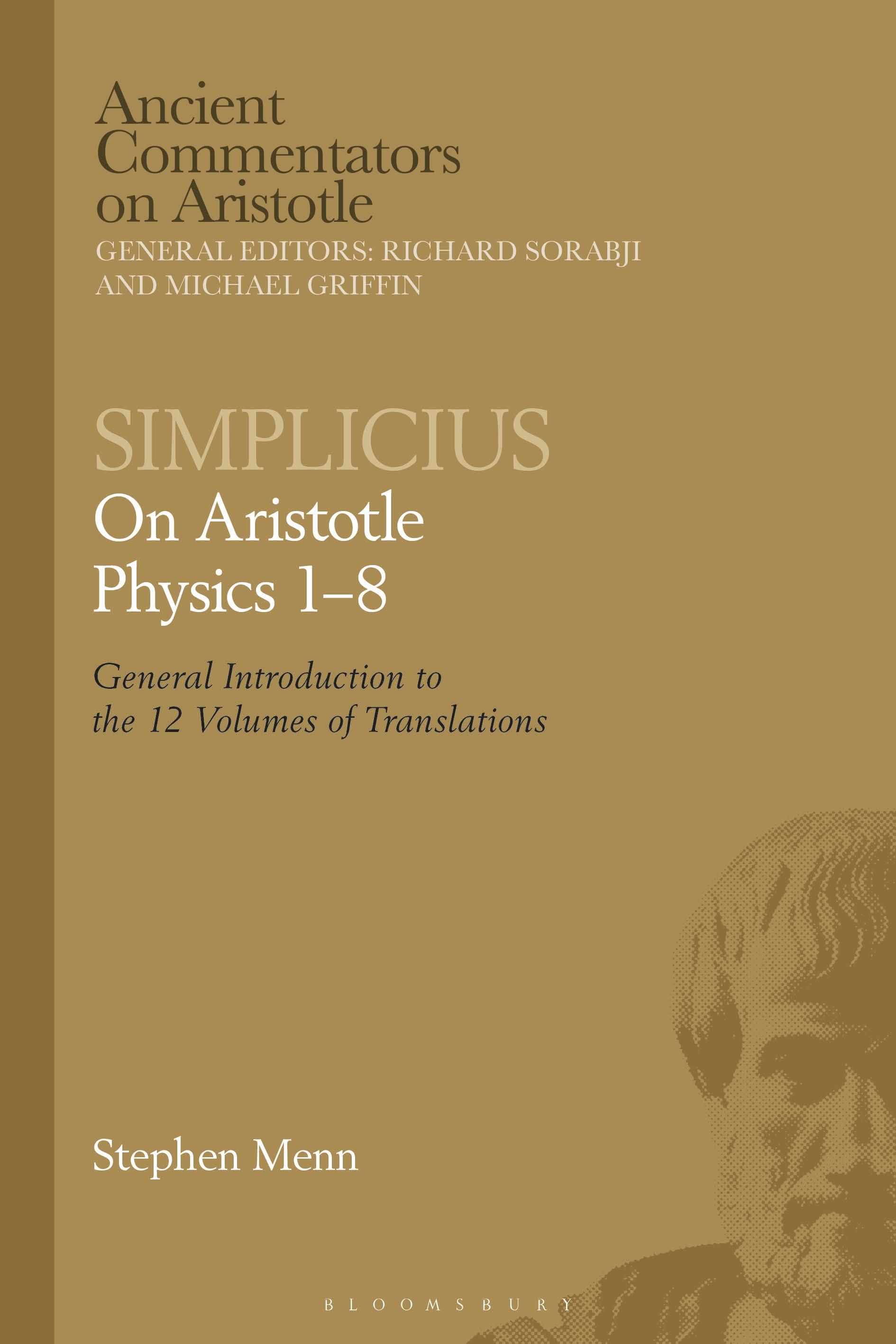
Supporting the twelve volumes of translation of Simplicius' great commentary on Aristotle's Physics, all published by Bloomsbury in the Ancient Commentators on Aristotle series, between 1992 and 2021, this volume presents a general introduction to the commentary. It covers the philosophical aims of Simplicius' commentaries on the Physics and the related text On the Heaven; Simplicius' methods and his use of earlier sources; and key themes and comparison with Philoponus' commentary on the same text.
Simplicius treats the Physics as a universal study of the principles of all natural things underlying the account of the cosmos in On the Heaven. In both treatises, he responds at every stage to the now lost Peripatetic commentaries of Alexander of Aphrodisias, which set Aristotle in opposition to Plato and to earlier thinkers such as Parmenides, Empedocles and Anaxagoras. On each passage, Simplicius after going through Alexander's commentary raises difficulties for the text of Aristotle as interpreted by Alexander. Then, after making observations about details of the text, and often going back to a direct reading of the older philosophers (for whom he is now often our main source, as he is for Alexander's commentary), he proposes his own solution to the difficulties, introduced with a modest 'perhaps', which reads Aristotle as in harmony with Plato and earlier thinkers.
Simplicius treats the Physics as a universal study of the principles of all natural things underlying the account of the cosmos in On the Heaven. In both treatises, he responds at every stage to the now lost Peripatetic commentaries of Alexander of Aphrodisias, which set Aristotle in opposition to Plato and to earlier thinkers such as Parmenides, Empedocles and Anaxagoras. On each passage, Simplicius after going through Alexander's commentary raises difficulties for the text of Aristotle as interpreted by Alexander. Then, after making observations about details of the text, and often going back to a direct reading of the older philosophers (for whom he is now often our main source, as he is for Alexander's commentary), he proposes his own solution to the difficulties, introduced with a modest 'perhaps', which reads Aristotle as in harmony with Plato and earlier thinkers.
Zahle einfach mit Karte, Klarna, Apple Pay oder Google Pay. Nicht zufrieden? Du hast immer ein 14-tägiges Widerrufsrecht. Lies mehr in unseren AGB. Hast du Fragen, schreib uns eine E-Mail an hello@memmo.org.
Memmo macht das Lernen einfacher – wo auch immer du bist. Bei uns findest du deine Kursbücher und smarte Lerntools an einem Ort: Zusammenfassungen, Quizzes, Podcasts und Lernkarten. Und Ted, dein Lernbuddy, beantwortet alles, was du wissen möchtest. Über 50.000 Studierende lernen bereits hier – gemacht, damit du schneller lernst und weniger Stress hast.