
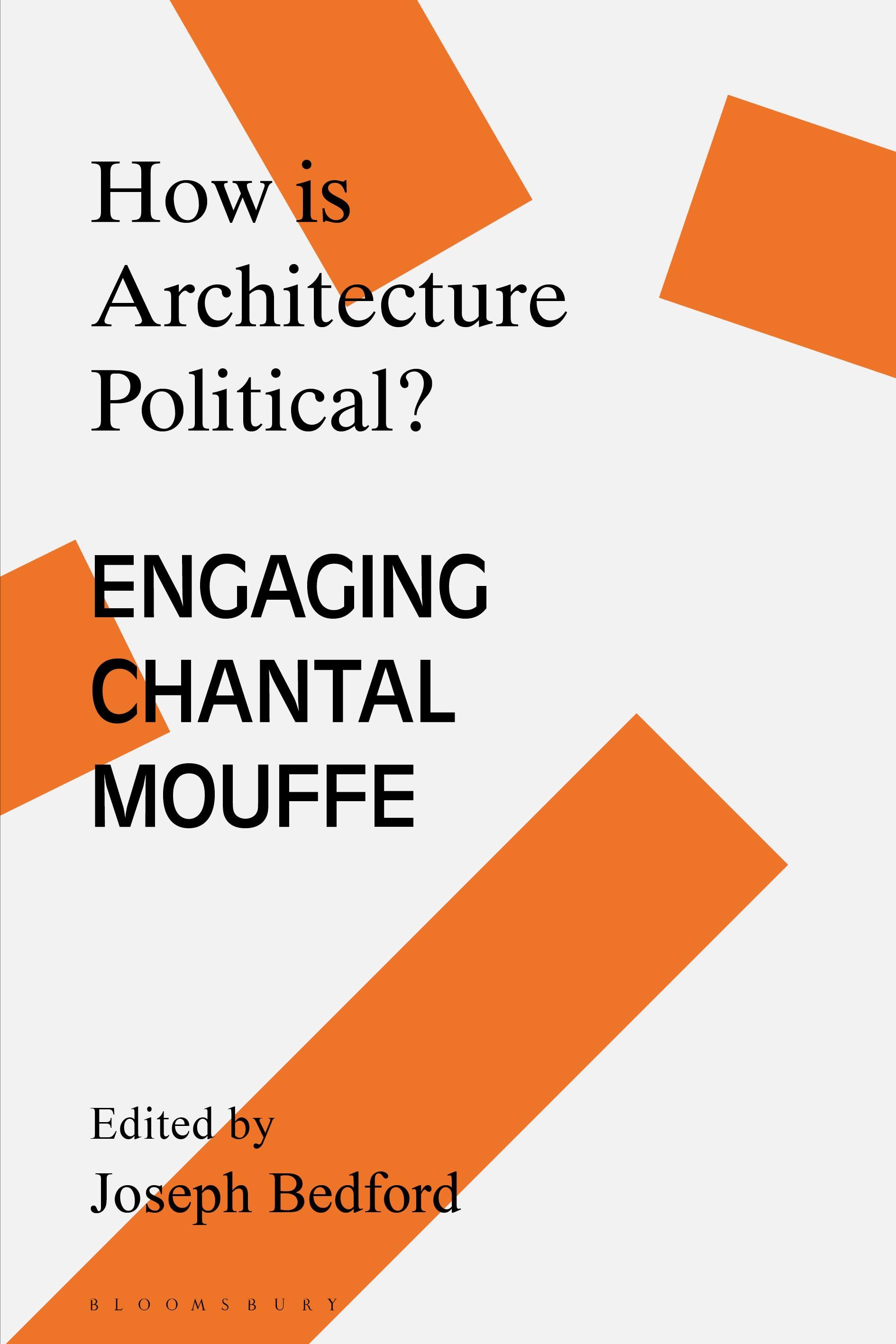
Chantal Mouffe has transformed the contemporary understanding of politics through her re-reading of political theory inspired by anti-foundationalist philosophy-based on Saussure's linguistics, Freud's psychoanalysis and Derrida's deconstruction. Her writings have challenged the centrist, post-political ideology of the 1990s and presciently diagnosed the emergence of right-wing populism seen today with Trump and Brexit. For Mouffe, such populism is the result of the failed centrist conception of politics reduced to technical management. She has called for a “return to politics” on the view that social antagonisms cannot be reconciled but must be channeled into an agonistic form of institutionally stabilized struggle.
This book brings Chantal Mouffe's agonistic model of politics into direct dialogue with architecture and inquiries into the role that architecture plays constructing the political order of society, either by concealing or revealing its antagonisms and ideological conflicts. In doing so, it asks in what ways architecture operates politically; whether institutionally, in terms of its spaces and its part in forming cities, or as an aesthetic object with mediatic agency. Through this detailed exchange between Mouffe and four of the world's leading architectural thinkers; Reinhold Martin, Ines Weizman, Pier Vittorio Aureli and Sarah Whiting, a debate unfolds within the book that tests the implications of Mouffe's agonistic model of politics for architectural practice today. Through this, Bedford explores how architectural history, architectural drawing, the making of spectacular monuments, the design and policies behind housing, and the making of public and private space, all potentially contribute to the formulation of the channeling of social conflict into an agonistic form.
This book brings Chantal Mouffe's agonistic model of politics into direct dialogue with architecture and inquiries into the role that architecture plays constructing the political order of society, either by concealing or revealing its antagonisms and ideological conflicts. In doing so, it asks in what ways architecture operates politically; whether institutionally, in terms of its spaces and its part in forming cities, or as an aesthetic object with mediatic agency. Through this detailed exchange between Mouffe and four of the world's leading architectural thinkers; Reinhold Martin, Ines Weizman, Pier Vittorio Aureli and Sarah Whiting, a debate unfolds within the book that tests the implications of Mouffe's agonistic model of politics for architectural practice today. Through this, Bedford explores how architectural history, architectural drawing, the making of spectacular monuments, the design and policies behind housing, and the making of public and private space, all potentially contribute to the formulation of the channeling of social conflict into an agonistic form.
Seiten: 192
Kategorie: Arkitektur & Stadsplanering
e-ISBN: 9781350263086
Versandgewicht: 1.2 kg
Versand in: 1-2 Tage
Zahle einfach mit Karte, Klarna, Apple Pay oder Google Pay. Nicht zufrieden? Du hast immer ein 14-tägiges Widerrufsrecht. Lies mehr in unseren AGB. Hast du Fragen, schreib uns eine E-Mail an hello@memmo.org.
Memmo macht das Lernen einfacher – wo auch immer du bist. Bei uns findest du deine Kursbücher und smarte Lerntools an einem Ort: Zusammenfassungen, Quizzes, Podcasts und Lernkarten. Und Ted, dein Lernbuddy, beantwortet alles, was du wissen möchtest. Über 50.000 Studierende lernen bereits hier – gemacht, damit du schneller lernst und weniger Stress hast.