
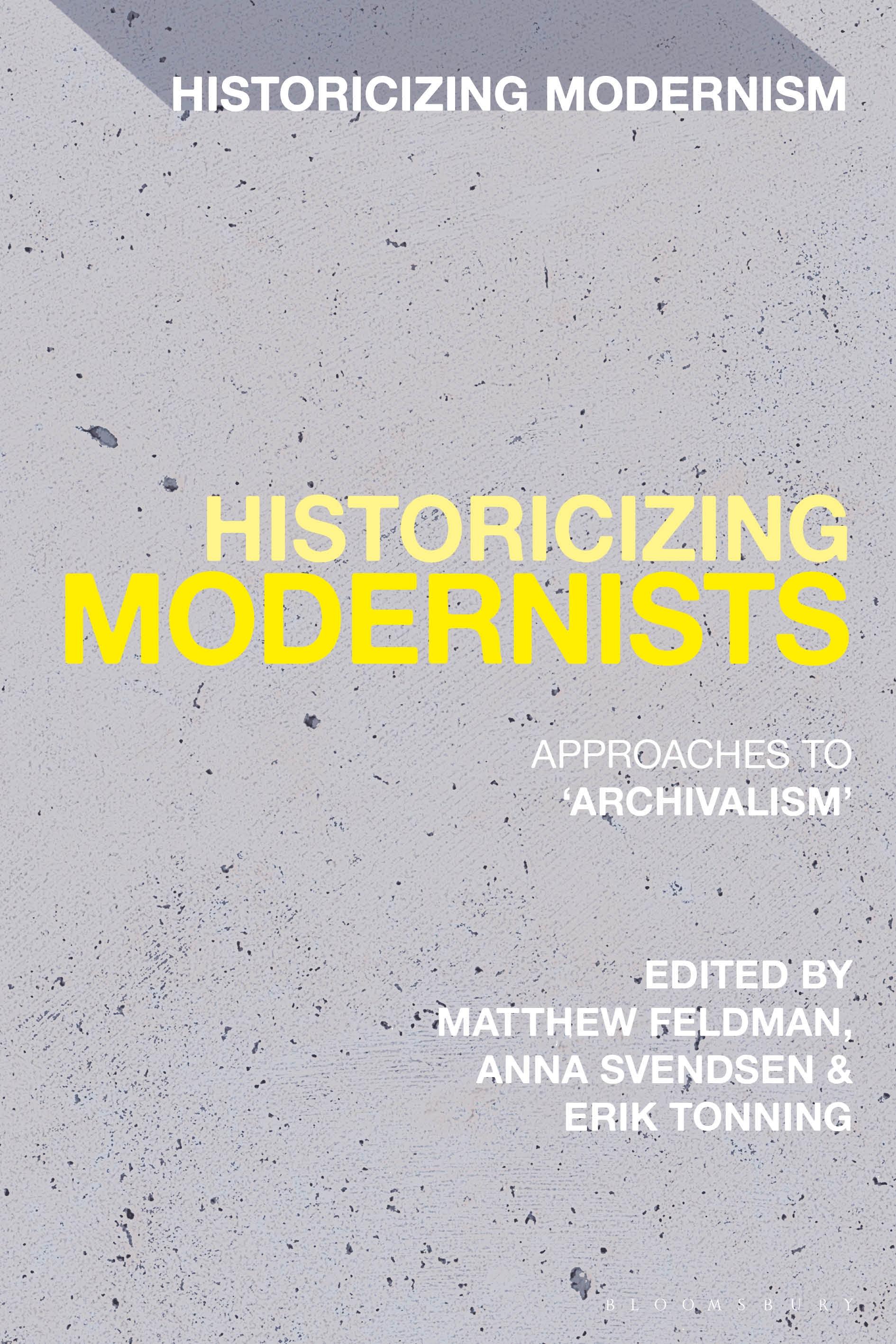
Focussing upon both canonical figures such as Woolf, Eliot, Pound, and Stein and emergent themes such as Christian modernism, intermedial modernism, queer Harlem Renaissance, this volume brings together previously unseen materials, from various archives, to bear upon cutting-edge interpretation of modernism. It provides an overview of approaches to modernism via the employment of various types of primary source material: correspondence, manuscripts and drafts, memoirs and production notes, reading notes and marginalia, and all manner of useful contextualising sources like news reports or judicial records.
While having much to say to literary criticism more broadly, this volume is closely focused upon key modernist figures and emergent themes in light of the discipline's 'archival turn' – termed in a unifying introduction 'achivalism'.
An essential ingredient separating the above, recent tendency from a much older and better-established new historicism, in modernist studies at least, is that 'the literary canon' remains an important starting point. Whereas new historicism 'is interested in history as represented and recorded in written documents' and tends toward a 'parallel study of literature and non-literary texts', archival criticism tends toward recognised, oftentimes canonical or critically-lauded, writers, presented in Part 1. Sidestepping the vicissitudes of canon formation, manuscript scholars tend to gravitate toward leading modernist authors: James Joyce, Ezra Pound, Virginia Woolf, Gertrude Stein, T.S. Eliot and Samuel Beckett. Part of the reason is obvious: known authors frequently leave behind sizeable literary estates, which are then acquired by research centres. A second section then applies the same empirical methodology to key or emergent themes in the study of modernism, including queer modernism; spatial modernism; little magazines (and online finding aids structuring them); and the role of faith and/or emotions in the construction of 'modernism' as we know it.
While having much to say to literary criticism more broadly, this volume is closely focused upon key modernist figures and emergent themes in light of the discipline's 'archival turn' – termed in a unifying introduction 'achivalism'.
An essential ingredient separating the above, recent tendency from a much older and better-established new historicism, in modernist studies at least, is that 'the literary canon' remains an important starting point. Whereas new historicism 'is interested in history as represented and recorded in written documents' and tends toward a 'parallel study of literature and non-literary texts', archival criticism tends toward recognised, oftentimes canonical or critically-lauded, writers, presented in Part 1. Sidestepping the vicissitudes of canon formation, manuscript scholars tend to gravitate toward leading modernist authors: James Joyce, Ezra Pound, Virginia Woolf, Gertrude Stein, T.S. Eliot and Samuel Beckett. Part of the reason is obvious: known authors frequently leave behind sizeable literary estates, which are then acquired by research centres. A second section then applies the same empirical methodology to key or emergent themes in the study of modernism, including queer modernism; spatial modernism; little magazines (and online finding aids structuring them); and the role of faith and/or emotions in the construction of 'modernism' as we know it.
Zahle einfach mit Karte, Klarna, Apple Pay oder Google Pay. Nicht zufrieden? Du hast immer ein 14-tägiges Widerrufsrecht. Lies mehr in unseren AGB. Hast du Fragen, schreib uns eine E-Mail an hello@memmo.org.
Memmo macht das Lernen einfacher – wo auch immer du bist. Bei uns findest du deine Kursbücher und smarte Lerntools an einem Ort: Zusammenfassungen, Quizzes, Podcasts und Lernkarten. Und Ted, dein Lernbuddy, beantwortet alles, was du wissen möchtest. Über 50.000 Studierende lernen bereits hier – gemacht, damit du schneller lernst und weniger Stress hast.