
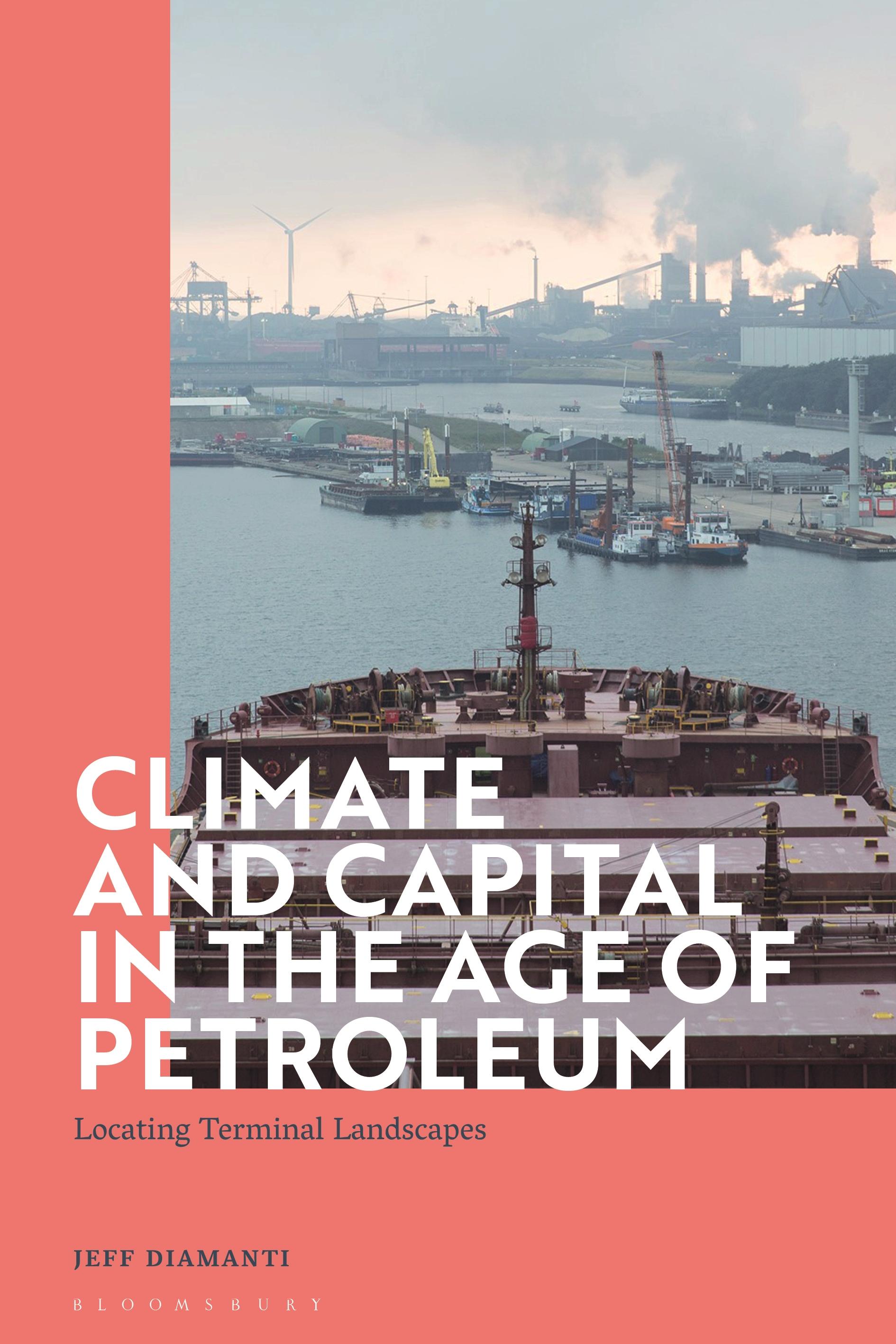
Jeff Diamanti describes the destructive relationship between climate and capital through the exponential growth of the petroleum industry over the last 40 years. Building on key insights in the environmental and energy humanities, Diamanti introduces the concept of the 'terminal landscape' as a site of storage, transformation and transition, essential to critical ecology in the 21st century.
Climate and Capital in the Age of Petroleum presents these scenes of transformation as sites through which post-industrial capitalism distributes fossil fuels into the world. Diamanti uses this concept to redefine the post-industrial landscape by revealing the global flows of exchange and storage that precede the distribution of fossil fuels into the world as social form. Advancing a new media theory of energy, fossil fuels and other finite resources become new types of distributable media. Through this line of thinking, the book makes solid connections between media technologies and energy cultures that help to shape a radical critique of the current energy infrastructure that characterises global capitalism.
Arguing that this infrastructure rests on millennia of compact matter, centuries of colonial violence, and decades of technological development, Diamanti's analysis deepens our understanding of the environment as a 'terminal landscape' through case studies of oil companies, countries, artworks, and historical events. Using his under-examined typology of global energy further theorises and politicises the climate crisis for scholars and activists alike.
Climate and Capital in the Age of Petroleum presents these scenes of transformation as sites through which post-industrial capitalism distributes fossil fuels into the world. Diamanti uses this concept to redefine the post-industrial landscape by revealing the global flows of exchange and storage that precede the distribution of fossil fuels into the world as social form. Advancing a new media theory of energy, fossil fuels and other finite resources become new types of distributable media. Through this line of thinking, the book makes solid connections between media technologies and energy cultures that help to shape a radical critique of the current energy infrastructure that characterises global capitalism.
Arguing that this infrastructure rests on millennia of compact matter, centuries of colonial violence, and decades of technological development, Diamanti's analysis deepens our understanding of the environment as a 'terminal landscape' through case studies of oil companies, countries, artworks, and historical events. Using his under-examined typology of global energy further theorises and politicises the climate crisis for scholars and activists alike.
Zahle einfach mit Karte, Klarna, Apple Pay oder Google Pay. Nicht zufrieden? Du hast immer ein 14-tägiges Widerrufsrecht. Lies mehr in unseren AGB. Hast du Fragen, schreib uns eine E-Mail an hello@memmo.org.
Memmo macht das Lernen einfacher – wo auch immer du bist. Bei uns findest du deine Kursbücher und smarte Lerntools an einem Ort: Zusammenfassungen, Quizzes, Podcasts und Lernkarten. Und Ted, dein Lernbuddy, beantwortet alles, was du wissen möchtest. Über 50.000 Studierende lernen bereits hier – gemacht, damit du schneller lernst und weniger Stress hast.