
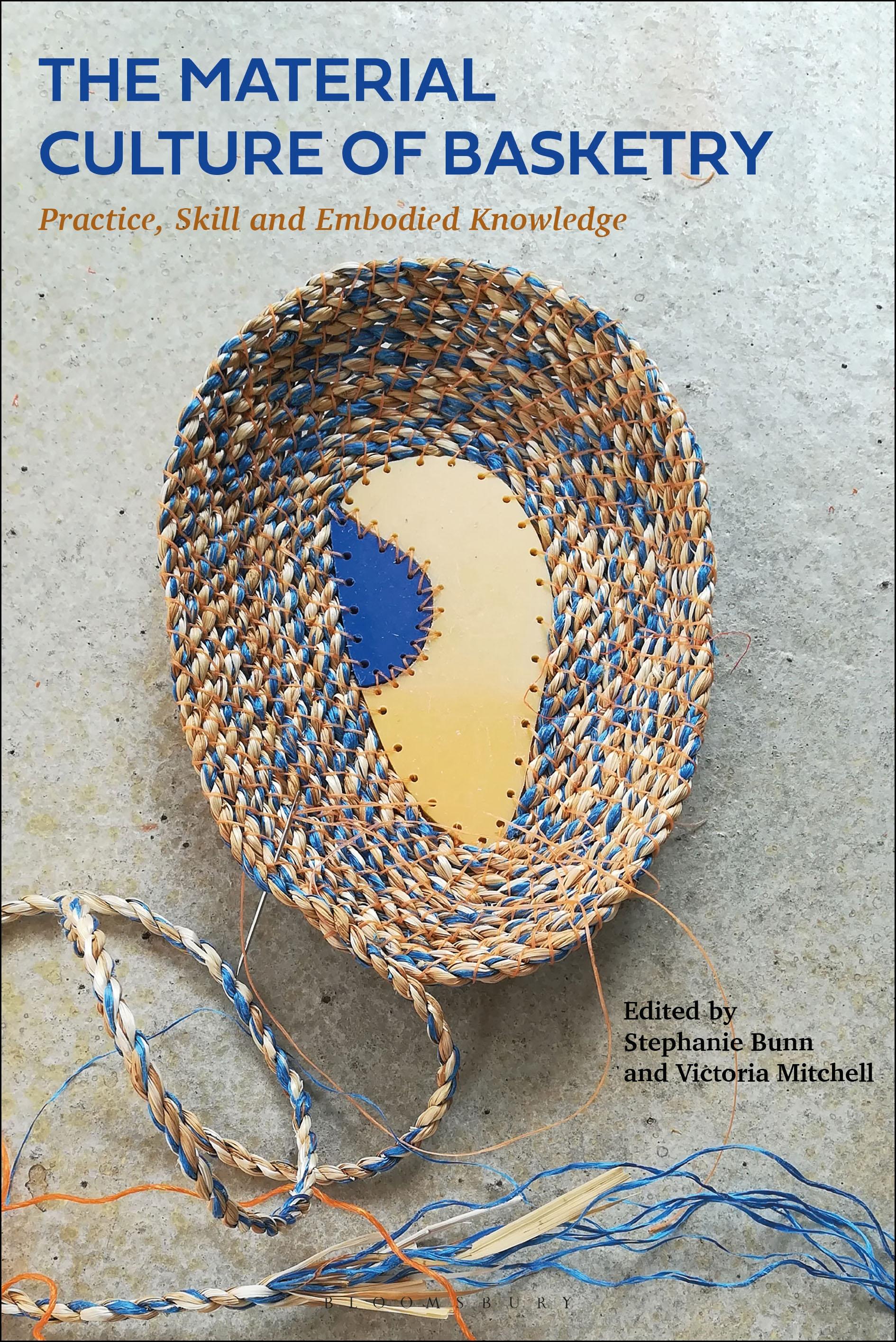
The Material Culture of Basketry celebrates basketry as a culturally significant skilled practice and as a theoretically rich discipline which has much to offer contemporary society. While sometimes understudied and underappreciated, it has much in common with mathematics and engineering, art, craft and design, and can also act as a socially beneficial source of skill and care.
Contributors show how local knowledge of materials, plants and place are central to the craft. Case studies include the skill in weaverbird nest building (challenging how we perceive learning in craft and nature), an engineer's perspective on twining Peruvian grass bridges, and the local knowledge embodied in Pacific plaited patterns and knots. Photo-essays explore materials and techniques from the point of view of artists, anthropologists and mathematicians, revealing how the structure and skill in basketwork illustrate a significant form of textile technology. Thus, the book argues that the textures, patterns and geometric forms that emerge through basketwork reflect an embodied knowledge which expresses mathematical and engineering comprehension.
The therapeutic value of the craft is recognised through a selection of case studies which consider basketry as a healing process for patients with brain injury, mental health problems, and as a memory aid for people living with dementia. This reclaims basketry's significant role in occupational therapy as an agent of recovery and well–being. Finally, basketry's inherently sustainable nature is also considered, demonstrating the continuation of basketry in spite of handwork's general decline and profiling new and recycled materials. Above all the book envisages basketry as an intellectually rewarding means of knowing. It presents the craft as embodying care for skilled making and for the social and natural environments in which it flourishes.
Contributors show how local knowledge of materials, plants and place are central to the craft. Case studies include the skill in weaverbird nest building (challenging how we perceive learning in craft and nature), an engineer's perspective on twining Peruvian grass bridges, and the local knowledge embodied in Pacific plaited patterns and knots. Photo-essays explore materials and techniques from the point of view of artists, anthropologists and mathematicians, revealing how the structure and skill in basketwork illustrate a significant form of textile technology. Thus, the book argues that the textures, patterns and geometric forms that emerge through basketwork reflect an embodied knowledge which expresses mathematical and engineering comprehension.
The therapeutic value of the craft is recognised through a selection of case studies which consider basketry as a healing process for patients with brain injury, mental health problems, and as a memory aid for people living with dementia. This reclaims basketry's significant role in occupational therapy as an agent of recovery and well–being. Finally, basketry's inherently sustainable nature is also considered, demonstrating the continuation of basketry in spite of handwork's general decline and profiling new and recycled materials. Above all the book envisages basketry as an intellectually rewarding means of knowing. It presents the craft as embodying care for skilled making and for the social and natural environments in which it flourishes.
Seiten: 312
Kategorie: Samhällsvetenskap
e-ISBN: 9781350094048
Versandgewicht: 1.2 kg
Versand in: 1-2 Tage
Zahle einfach mit Karte, Klarna, Apple Pay oder Google Pay. Nicht zufrieden? Du hast immer ein 14-tägiges Widerrufsrecht. Lies mehr in unseren AGB. Hast du Fragen, schreib uns eine E-Mail an hello@memmo.org.
Memmo macht das Lernen einfacher – wo auch immer du bist. Bei uns findest du deine Kursbücher und smarte Lerntools an einem Ort: Zusammenfassungen, Quizzes, Podcasts und Lernkarten. Und Ted, dein Lernbuddy, beantwortet alles, was du wissen möchtest. Über 50.000 Studierende lernen bereits hier – gemacht, damit du schneller lernst und weniger Stress hast.