
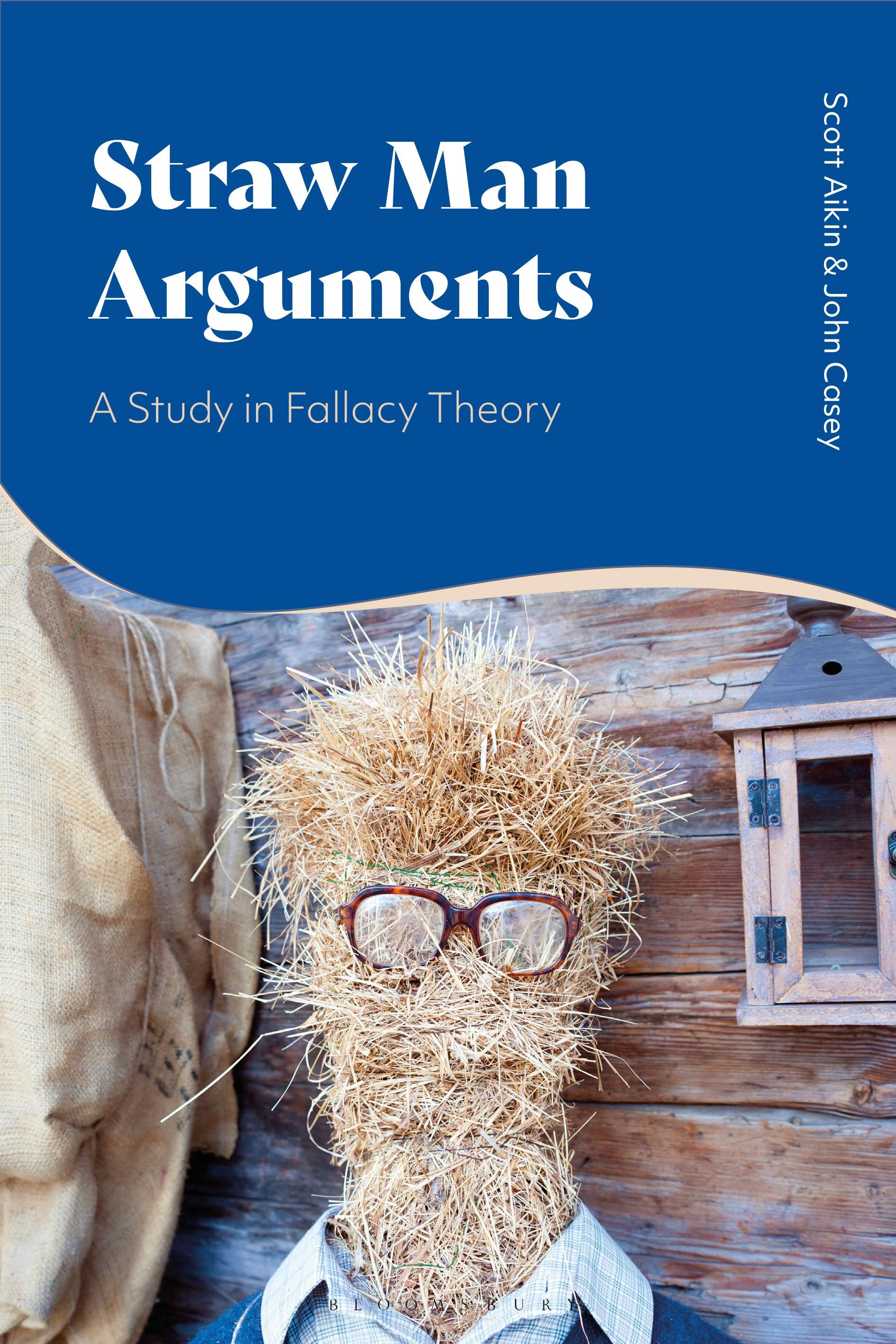
This book analyses the straw man fallacy and its deployment in philosophical reasoning. While commonly invoked in both academic dialogue and public discourse, it has not until now received the attention it deserves as a rhetorical device.
Scott Aikin and John Casey propose that straw manning essentially consists in expressing distorted representations of one's critical interlocutor. To this end, the straw man comprises three dialectical forms, and not only the one that is usually suggested: the straw man, the weak man and the hollow man. Moreover, they demonstrate that straw manning is unique among fallacies as it has no particular logical form in itself, because it is an instance of inappropriate meta-argument, or argument about arguments. They discuss the importance of the onlooking audience to the successful deployment of the straw man, reasoning that the existence of an audience complicates the dialectical boundaries of argument.
Providing a lively, provocative and thorough analysis of the straw man fallacy, this book will appeal to postgraduates and researchers alike, working in a range of fields including fallacies, rhetoric, argumentation theory and informal logic.
Scott Aikin and John Casey propose that straw manning essentially consists in expressing distorted representations of one's critical interlocutor. To this end, the straw man comprises three dialectical forms, and not only the one that is usually suggested: the straw man, the weak man and the hollow man. Moreover, they demonstrate that straw manning is unique among fallacies as it has no particular logical form in itself, because it is an instance of inappropriate meta-argument, or argument about arguments. They discuss the importance of the onlooking audience to the successful deployment of the straw man, reasoning that the existence of an audience complicates the dialectical boundaries of argument.
Providing a lively, provocative and thorough analysis of the straw man fallacy, this book will appeal to postgraduates and researchers alike, working in a range of fields including fallacies, rhetoric, argumentation theory and informal logic.
Zahle einfach mit Karte, Klarna, Apple Pay oder Google Pay. Nicht zufrieden? Du hast immer ein 14-tägiges Widerrufsrecht. Lies mehr in unseren AGB. Hast du Fragen, schreib uns eine E-Mail an hello@memmo.org.
Memmo macht das Lernen einfacher – wo auch immer du bist. Bei uns findest du deine Kursbücher und smarte Lerntools an einem Ort: Zusammenfassungen, Quizzes, Podcasts und Lernkarten. Und Ted, dein Lernbuddy, beantwortet alles, was du wissen möchtest. Über 50.000 Studierende lernen bereits hier – gemacht, damit du schneller lernst und weniger Stress hast.