
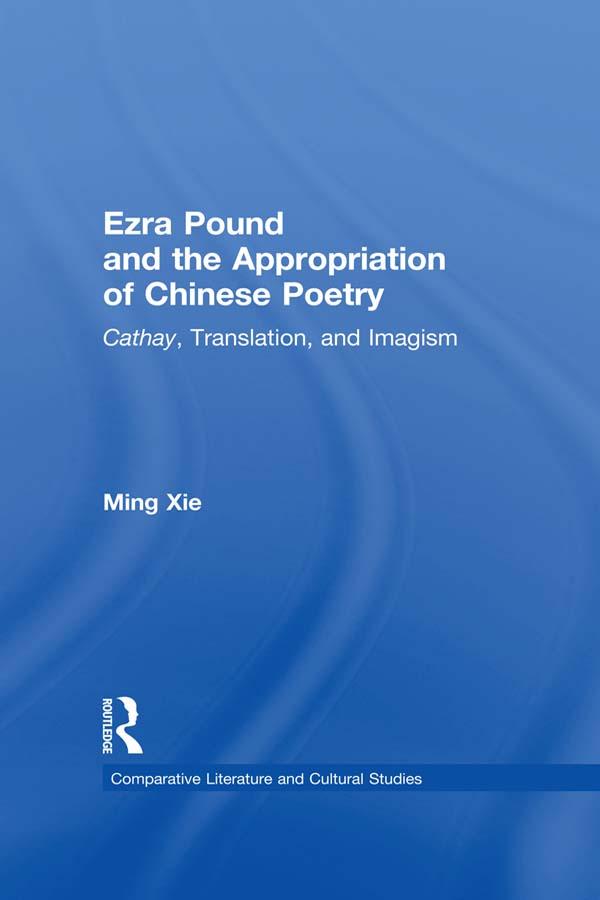
This book focuses on the relations between the translation and appropriation of classical Chinese poetry by Ezra Pound and some of his contemporaries and the development of Anglo-American Imagist poetry and poetics. It is concerned as much with critical aspects of this correlative relationship as with the question of historical influence and ascription. The author places the early work of Ezra Pound in the context of works of Chinese translation by other contemporary poet-translators such as Arthur Waley and Amy Lowell, and examines the whole notion of an ideogrammic poetry as advocated by Ernest Fenollosa and Ezra Pound against an appropriately reconstructed historical and critical context of poetic theory and practice. Closely linked to this is a discussion of Pound's use of personae and modulation of the elegiac in relation to the immediately preceding context of late Victorian elegiac lyricism and Brownigesque dramatic monologue. Through a series of close readings of translations from the Chinese, especially those by Pound, the author shows how the critical problem of what is involved in translating a Chinese poem into a new English poem is closely linked to the particulars of early Modernist literary history. In particular, through tracing the trajectory of a number of central issues and notions, such as absolute, free-floating, metaphor, metaphor as epiphanic image and its relation to syntax, metaphor and parallelism, experiments with rhythm and cadence, the book explores some of the reasons for Fenollosa's and Pound's emphasis on the visual image, the notion of phanopoeia and ideogrammic verbal action as the active perceiving of relations, and closely examines the genesis and significance of Pound's ideogrammic method, as well as the question of cultural misreading and vicarious envisagement, and provides a critical overview of Pound's general engagement with translation.
Seiten: 293
Kategorie: Litteraturvetenskap & Teori
e-ISBN: 9781317945024
Versandgewicht: 1.2 kg
Versand in: 1-2 Tage
Zahle einfach mit Karte, Klarna, Apple Pay oder Google Pay. Nicht zufrieden? Du hast immer ein 14-tägiges Widerrufsrecht. Lies mehr in unseren AGB. Hast du Fragen, schreib uns eine E-Mail an hello@memmo.org.
Memmo macht das Lernen einfacher – wo auch immer du bist. Bei uns findest du deine Kursbücher und smarte Lerntools an einem Ort: Zusammenfassungen, Quizzes, Podcasts und Lernkarten. Und Ted, dein Lernbuddy, beantwortet alles, was du wissen möchtest. Über 50.000 Studierende lernen bereits hier – gemacht, damit du schneller lernst und weniger Stress hast.
Das könnte dir auch gefallen
Buch kaufen0