
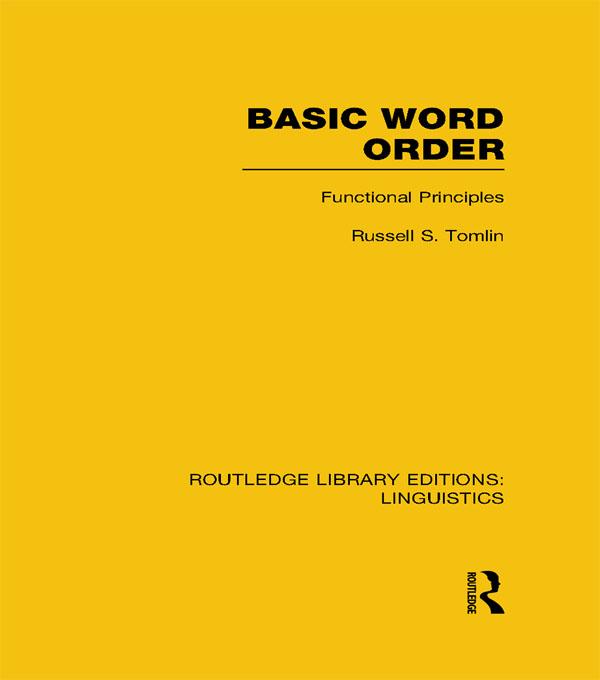
This book examines the frequencies of the six possible basic word (or constituent) orders (SOV, SVO, VSO, VOS, OSV, OVS) provides a typologically grounded explanation for those frequencies in terms of three independent, functional principles of linguistic organization.
From a database of nearly 1,000 languages and their basic constituent orders, a sample of 400 languages was produced that is statistically representative of both the genetic and areal distributions of the world’s languages. This sample reveals the following relative frequencies (in order from high to low) of basic constituent order types: (1) SOV and SVO, (2) VSO, (3) VOS and OVS, (4) OSV.
It is argued that these relative frequencies can be explained to be the result of the possible interactions of three fundamental functional principles of linguistic organization. Principle 1, the thematic information principle, specifies that initial position is the cross-linguistically favoured position for clause-level thematic information. Principle 2, the verb-object bonding principle, describes the cross-linguistic tendency for a transitive verb and its object to form a more tightly integrated unit, syntactically and semantically, than does a transitive verb and its subject. Principle 3, the animated principle, describes the cross-linguistic tendency for semantic arguments which are either more animate or more agentive to occur earlier in the clause. Each principle is motivated independently of the others, drawing on cross-linguistic data from more than 80 genetically and typologically diverse languages.
Given these three independently motivated functional principles, it is argued that the relative frequency of basic constituent order types is due to the tendency for the three principles to be maximally realized in the world’s languages. SOV and SVO languages are typologically most frequent because such basic orders reflect all three principles. The remaining orders occur less frequently because they reflect fewer of the principles.
The 1,000-language database and the genetic and areal classification frames are published as appendices to the volume.
Zahle einfach mit Karte, Klarna, Apple Pay oder Google Pay. Nicht zufrieden? Du hast immer ein 14-tägiges Widerrufsrecht. Lies mehr in unseren AGB. Hast du Fragen, schreib uns eine E-Mail an hello@memmo.org.
Memmo macht das Lernen einfacher – wo auch immer du bist. Bei uns findest du deine Kursbücher und smarte Lerntools an einem Ort: Zusammenfassungen, Quizzes, Podcasts und Lernkarten. Und Ted, dein Lernbuddy, beantwortet alles, was du wissen möchtest. Über 50.000 Studierende lernen bereits hier – gemacht, damit du schneller lernst und weniger Stress hast.