
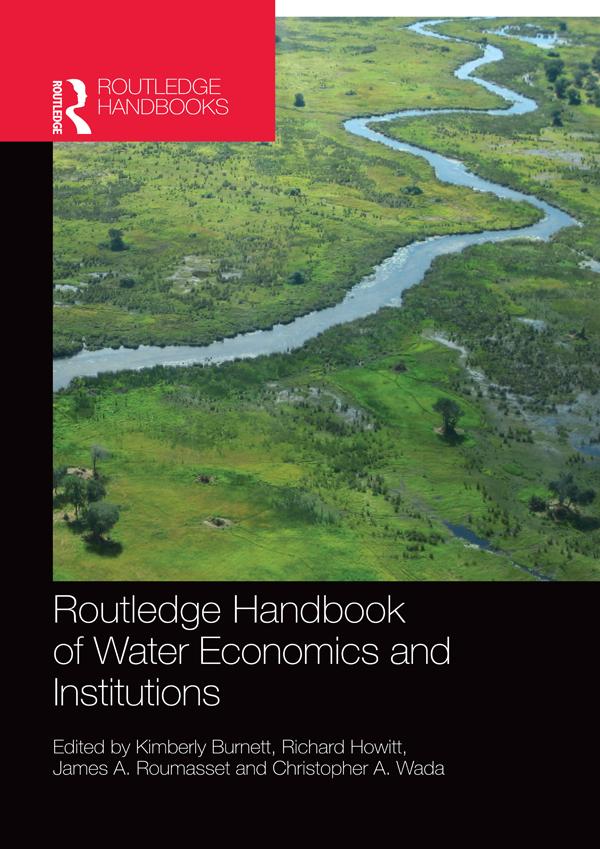
Growing scarcity of freshwater worldwide brings to light the need for sound water resource modeling and policy analysis. While a solid foundation has been established for many specific water management problems, combining those methods and principles in a unified framework remains an ongoing challenge. This Handbook aims to expand the scope of efficient water use to include allocation of sources and quantities across uses and time, as well as integrating demand-management with supply-side substitutes.
Socially efficient water use does not generally coincide with private decisions in the real world, however. Examples of mechanisms designed to incentivize efficient behavior are drawn from agricultural water use, municipal water regulation, and externalities linked to water resources. Water management is further complicated when information is costly and/or imperfect. Standard optimization frameworks are extended to allow for coordination costs, games and cooperation, and risk allocation. When operating efficiently, water markets are often viewed as a desirable means of allocation because a market price incentivizes users to move resources from low to high value activities. However, early attempts at water trading have run into many obstacles. Case studies from the United States, Australia, Europe, and Canada highlight the successes and remaining challenges of establishing efficient water markets.
Zahle einfach mit Karte, Klarna, Apple Pay oder Google Pay. Nicht zufrieden? Du hast immer ein 14-tägiges Widerrufsrecht. Lies mehr in unseren AGB. Hast du Fragen, schreib uns eine E-Mail an hello@memmo.org.
Memmo macht das Lernen einfacher – wo auch immer du bist. Bei uns findest du deine Kursbücher und smarte Lerntools an einem Ort: Zusammenfassungen, Quizzes, Podcasts und Lernkarten. Und Ted, dein Lernbuddy, beantwortet alles, was du wissen möchtest. Über 50.000 Studierende lernen bereits hier – gemacht, damit du schneller lernst und weniger Stress hast.