
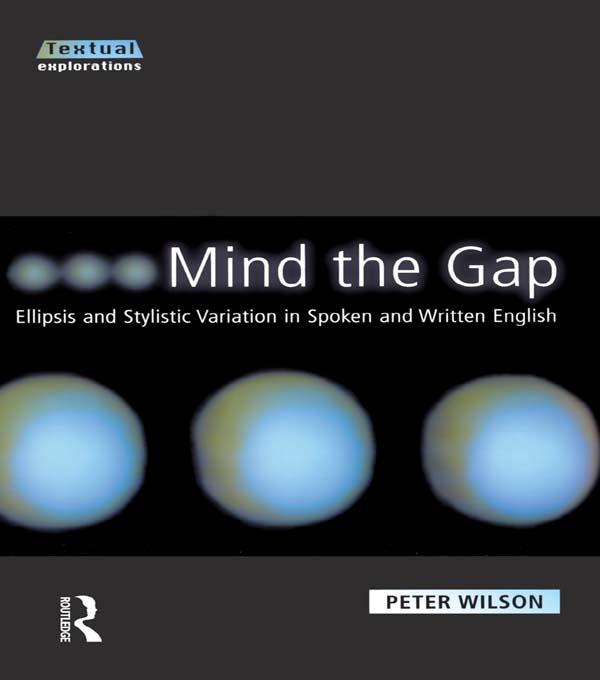
We rarely speak or even write in the complete sentences that are often held to be the ideal form of linguistic communication. Language is, in fact, full of gaps, because speakers and writers operate in contexts which allow bits of language to be understood rather than expressed. This book systematically analyses this inherent gappiness of language, known as ellipsis, and provides an account of the different contexts, both linguistic and situational, which affect its use. Peter Wilson draws on a wide variety of examples of spoken and written English, and both literary and non-literary to present a comprehensive classification of elliptical language that ranges from the conversational fragment and the advertisement to the dialogue of Shakespeare and imagist poetry. Mind the Gap shows how ellipsis is a feature of major structural and stylistic importance to our understanding of spoken and written language, and will be of interest to undergraduate students of linguistics, literature, communication and the interrelations between them..
Zahle einfach mit Karte, Klarna, Apple Pay oder Google Pay. Nicht zufrieden? Du hast immer ein 14-tägiges Widerrufsrecht. Lies mehr in unseren AGB. Hast du Fragen, schreib uns eine E-Mail an hello@memmo.org.
Memmo macht das Lernen einfacher – wo auch immer du bist. Bei uns findest du deine Kursbücher und smarte Lerntools an einem Ort: Zusammenfassungen, Quizzes, Podcasts und Lernkarten. Und Ted, dein Lernbuddy, beantwortet alles, was du wissen möchtest. Über 50.000 Studierende lernen bereits hier – gemacht, damit du schneller lernst und weniger Stress hast.