
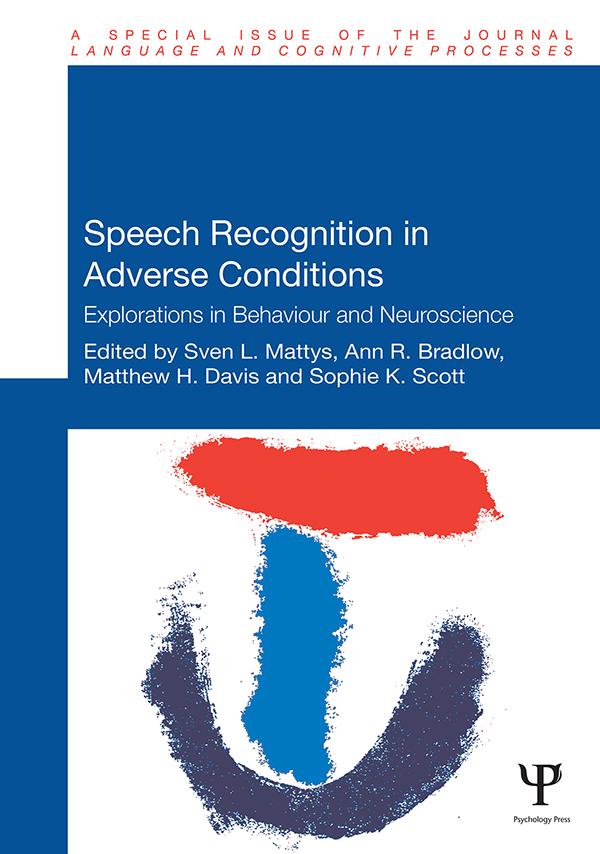
Speech recognition in ‘adverse conditions’ has been a familiar area of research in computer science, engineering, and hearing sciences for several decades. In contrast, most psycholinguistic theories of speech recognition are built upon evidence gathered from tasks performed by healthy listeners on carefully recorded speech, in a quiet environment, and under conditions of undivided attention.
Building upon the momentum initiated by the Psycholinguistic Approaches to Speech Recognition in Adverse Conditions workshop held in Bristol, UK, in 2010, the aim of this volume is to promote a multi-disciplinary, yet unified approach to the perceptual, cognitive, and neuro-physiological mechanisms underpinning the recognition of degraded speech, variable speech, speech experienced under cognitive load, and speech experienced by theoretically relevant populations.
This collection opens with a review of the literature and a formal classification of adverse conditions. The research articles then highlight those adverse conditions with the greatest potential for constraining theory, showing that some speech phenomena often believed to be immutable can be affected by noise, surface variations, or attentional set in ways that will force researchers to rethink their theory. This volume is essential for those interested in speech recognition outside laboratory constraints.
Zahle einfach mit Karte, Klarna, Apple Pay oder Google Pay. Nicht zufrieden? Du hast immer ein 14-tägiges Widerrufsrecht. Lies mehr in unseren AGB. Hast du Fragen, schreib uns eine E-Mail an hello@memmo.org.
Memmo macht das Lernen einfacher – wo auch immer du bist. Bei uns findest du deine Kursbücher und smarte Lerntools an einem Ort: Zusammenfassungen, Quizzes, Podcasts und Lernkarten. Und Ted, dein Lernbuddy, beantwortet alles, was du wissen möchtest. Über 50.000 Studierende lernen bereits hier – gemacht, damit du schneller lernst und weniger Stress hast.