
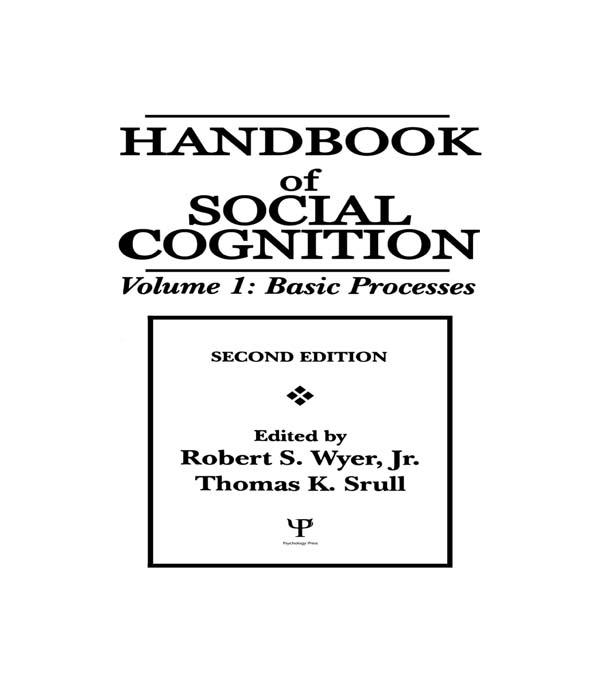
This edition of the Handbook follows the first edition by 10 years. The earlier edition was a promissory note, presaging the directions in which the then-emerging field of social cognition was likely to move. The field was then in its infancy and the areas of research and theory that came to dominate the field during the next decade were only beginning to surface. The concepts and methods used had frequently been borrowed from cognitive psychology and had been applied to phenomena in a very limited number of areas. Nevertheless, social cognition promised to develop rapidly into an important area of psychological inquiry that would ultimately have an impact on not only several areas of psychology but other fields as well.
The promises made by the earlier edition have generally been fulfilled. Since its publication, social cognition has become one of the most active areas of research in the entire field of psychology; its influence has extended to health and clinical psychology, and personality, as well as to political science, organizational behavior, and marketing and consumer behavior. The impact of social cognition theory and research within a very short period of time is incontrovertible. The present volumes provide a comprehensive and detailed review of the theoretical and empirical work that has been performed during these years, and of its implications for information processing in a wide variety of domains.
The handbook is divided into two volumes. The first provides an overview of basic research and theory in social information processing, covering the automatic and controlled processing of information and its implications for how information is encoded and stored in memory, the mental representation of persons -- including oneself -- and events, the role of procedural knowledge in information processing, inference processes, and response processes. Special attention is given to the cognitive determinants and consequences of affect and emotion. The second book provides detailed discussions of the role of information processing in specific areas such as stereotyping; communication and persuasion; political judgment; close relationships; organizational, clinical and health psychology; and consumer behavior.
The contributors are theorists and researchers who have themselves carried out important studies in the areas to which their chapters pertain. In combination, the contents of this two-volume set provide a sophisticated and in-depth treatment of both theory and research in this major area of psychological inquiry and the directions in which it is likely to proceed in the future.
Zahle einfach mit Karte, Klarna, Apple Pay oder Google Pay. Nicht zufrieden? Du hast immer ein 14-tägiges Widerrufsrecht. Lies mehr in unseren AGB. Hast du Fragen, schreib uns eine E-Mail an hello@memmo.org.
Memmo macht das Lernen einfacher – wo auch immer du bist. Bei uns findest du deine Kursbücher und smarte Lerntools an einem Ort: Zusammenfassungen, Quizzes, Podcasts und Lernkarten. Und Ted, dein Lernbuddy, beantwortet alles, was du wissen möchtest. Über 50.000 Studierende lernen bereits hier – gemacht, damit du schneller lernst und weniger Stress hast.