
As Skinner argued so pointedly, the more we know about the situational causes of psychological phenomena, the less need we have for postulating internal conscious mediating processes to explain those phenomena. Now, as the purview of social psychology is precisely to discover those situational causes of thinking, feeling, and acting in the real or implied presence of other people, it is hard to escape the forecast that as knowledge progresses regarding social psychological phenomena there will be less of a role played by free will or conscious choice in accounting for them. In other words, because of social psychology's natural focus on the situational determinants of thinking, feeling, and doing, it is inevitable that social psychological phenomena increasingly will be found to be automatic in nature.
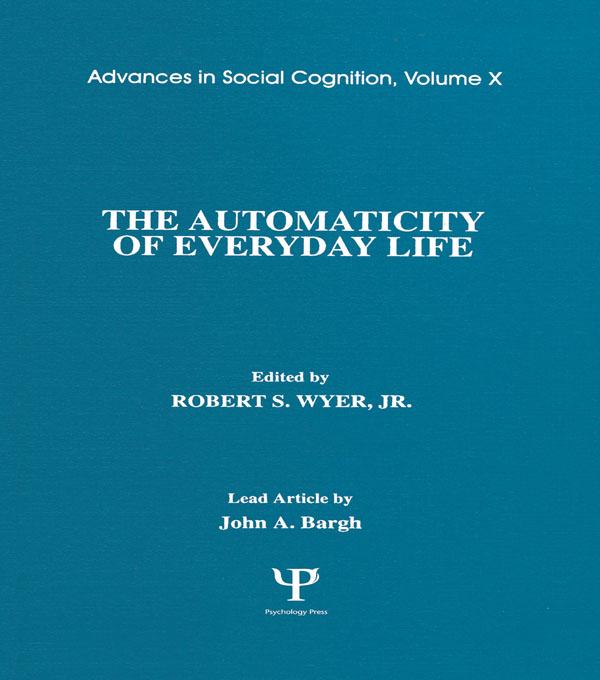
This 10th book in the series addresses automaticity and how it relates to social behavior. The lead article, written by John Bargh, argues that social psychology phenomena are essentially automatic in nature, as opposed to being mediated by conscious choice or reflection. Bargh maintains that an automatic mental phenomenon is that which occurs reflexively whenever certain triggering conditions are in place; when those conditions are present, the process runs off autonomously, independently of conscious guidance. In his lead article, he focuses on these preconscious automatic processes that can be contrasted with postconscious and goal-dependent forms of automaticity which depend on more than the mere presence of environmental objects or events. Because social psychology, like automaticity theory and research, is also largely concerned with phenomena that occur whenever certain situational features or factors are in place, social psychology phenomena are essentially automatic. Students and researchers in social and cognitive psychology will find this to be a provocative addition to the series.
Zahle einfach mit Karte, Klarna, Apple Pay oder Google Pay. Nicht zufrieden? Du hast immer ein 14-tägiges Widerrufsrecht. Lies mehr in unseren AGB. Hast du Fragen, schreib uns eine E-Mail an hello@memmo.org.
Memmo macht das Lernen einfacher – wo auch immer du bist. Bei uns findest du deine Kursbücher und smarte Lerntools an einem Ort: Zusammenfassungen, Quizzes, Podcasts und Lernkarten. Und Ted, dein Lernbuddy, beantwortet alles, was du wissen möchtest. Über 50.000 Studierende lernen bereits hier – gemacht, damit du schneller lernst und weniger Stress hast.