
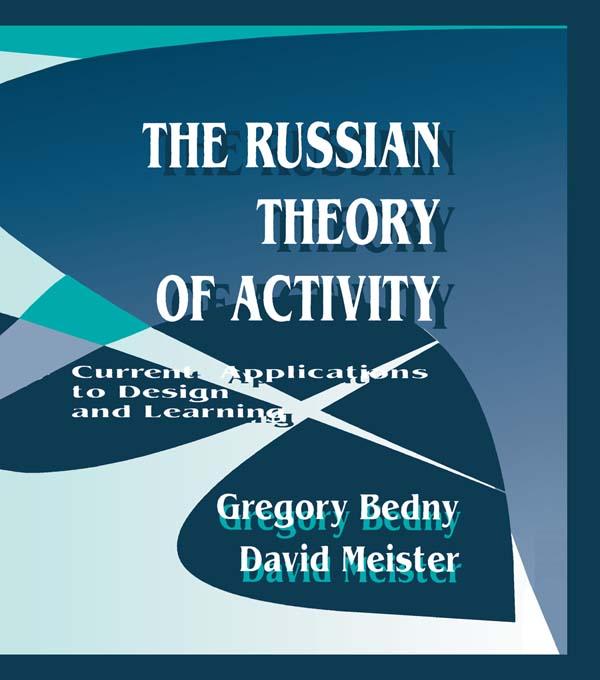
The opening of the former Soviet Union to the West has provided an opportunity to describe Russian human factors/ergonomics and to compare American theories and methods with it. Although this book is principally dedicated to describing the theory of activity as it applies to issues of design and training, it is also offered to a general audience of psychologists and interested lay readers. This theory studies the goal-directed behavior of man and attempts to integrate the cognitive, motivational, and behavioral aspects of activity into a holistic system. Such fundamental notions as goal, action, and self-regulation are described and analyzed from totally different theoretical points of view.
This is the first comprehensive, systematic description of the theory of activity in the English language. Existing attempts to translate the theory of activity into English suffer from certain limitations. Among them, the theory of activity -- considered one of the more important accomplishments of Soviet psychological science -- has an extensive history dating back to the work of Vygotsky and his students. Subsequent development of the theory by other well-known Soviet psychologists and psychophysiologists took place within different schools with some significant differences. In the former Soviet Union, psychological theory could not be advanced unconnected to Marxist-Leninist ideology. Accordingly, theoretical formulations were subject to their own version of "political correctness." Books published in this field were addressed only to other scientists with backgrounds in the field. Moreover, the translation of the technical terms in Russian psychology frequently resist translation in the absence of the context of the debates in which they were being used. Thus, simple translation of books in this field as they were written in a specialized and politicized environment for Russian audiences is really not a particularly sensible or worthwhile undertaking.
This book is addressed in the first instance to Western psychologists. It compares, among other things, analyses of work from the former Soviet Union with the work from the West. Applications of activity theory to design and learning were paramount in the Soviet Union. Using their own theoretical perspective, the authors provide a comparative analysis of the various schools working in activity theory. They hope that this book may facilitate the exchange of ideas between Russian psychological scientists and Western psychologists working in ergonomics, human factors, industrial/organizational psychology, education, learning, and related areas where the theory of activity may find general application.
This book's authors attempt to provide a contribution not only to science but also to history. Western researchers have strongly influenced Russian work, but because of negative political pressure in the former USSR, the flow of concepts was one-sided. Russian ergonomists received so much from American and Western sources that it is now important to give something back. Despite the considerable similarity between Russian and American theories and methods, the special "spin" the former put on their work may stimulate new thinking on the part of their American colleagues.
Zahle einfach mit Karte, Klarna, Apple Pay oder Google Pay. Nicht zufrieden? Du hast immer ein 14-tägiges Widerrufsrecht. Lies mehr in unseren AGB. Hast du Fragen, schreib uns eine E-Mail an hello@memmo.org.
Memmo macht das Lernen einfacher – wo auch immer du bist. Bei uns findest du deine Kursbücher und smarte Lerntools an einem Ort: Zusammenfassungen, Quizzes, Podcasts und Lernkarten. Und Ted, dein Lernbuddy, beantwortet alles, was du wissen möchtest. Über 50.000 Studierende lernen bereits hier – gemacht, damit du schneller lernst und weniger Stress hast.