
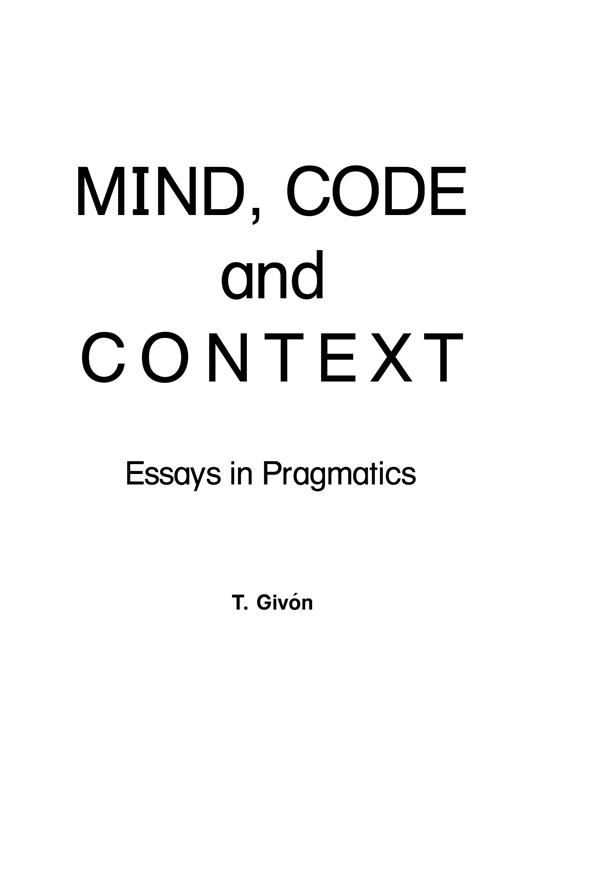
Scholars concerned with the phenomenon of mind have searched through history for a principled yet non-reductionist approach to the study of knowledge, communication, and behavior. Pragmatics has been a recurrent theme in Western epistemology, tracing itself back from pre-Socratic dialectics and Aristotle's bio- functionalism, all the way to Wittgenstein's content-dependent semantics.
This book's treatment of pragmatics as an analytic method focuses on the central role of context in determining the perception, organization, and communication of experience. As a bioadaptive strategy, pragmatics straddles the middle ground between absolute categories and the non-discrete gradation of experience, reflecting closely the organism's own evolutionary compromises. In parallel, pragmatic reasoning can be shown to play a pivotal role in the process of empirical science, through the selection of relevant facts, the abduction of likely hypotheses, and the construction of non-trivial explanations.
In this volume, Professor Givon offers pragmatics as both an analytic method and a strategic intellectual framework. He points out its relevance to our understanding of traditional problems in philosophy, anthropology, linguistics, cognitive psychology, neuro-biology, and evolution. Finally, the application of pragmatics to the study of the mind and behavior constitutes an implicit challenge to the current tenets of artificial intelligence.
Zahle einfach mit Karte, Klarna, Apple Pay oder Google Pay. Nicht zufrieden? Du hast immer ein 14-tägiges Widerrufsrecht. Lies mehr in unseren AGB. Hast du Fragen, schreib uns eine E-Mail an hello@memmo.org.
Memmo macht das Lernen einfacher – wo auch immer du bist. Bei uns findest du deine Kursbücher und smarte Lerntools an einem Ort: Zusammenfassungen, Quizzes, Podcasts und Lernkarten. Und Ted, dein Lernbuddy, beantwortet alles, was du wissen möchtest. Über 50.000 Studierende lernen bereits hier – gemacht, damit du schneller lernst und weniger Stress hast.