
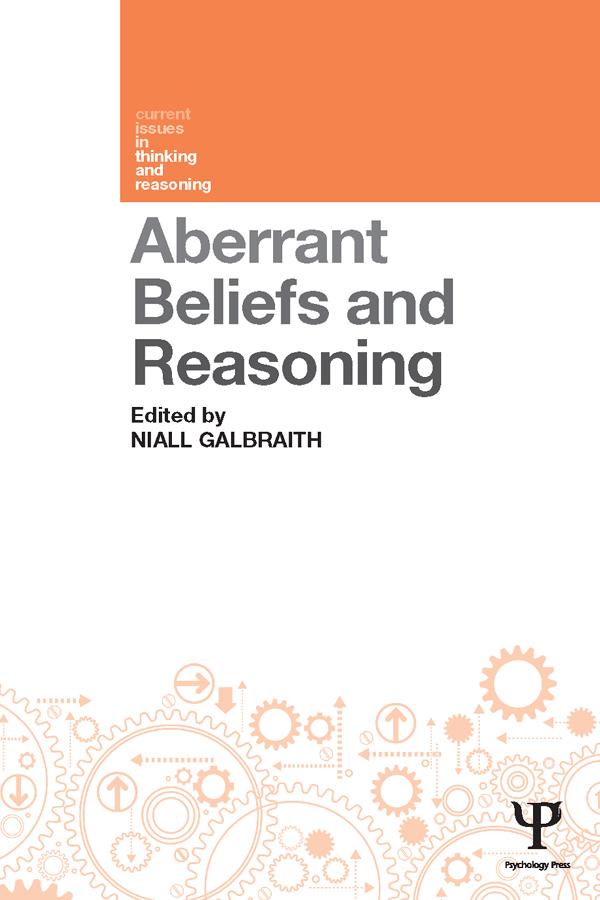
An aberrant belief is extreme or unusual in nature. In the most serious cases these beliefs cause emotional distress in those who hold them, and typify the core symptoms of psychological disorders. Each of the chapters in this volume seeks to examine the role that biases in reasoning can play in the formation of aberrant beliefs.
The chapters consider several conjectures about the role of reasoning in aberrant belief, including the role of the jumping to conclusion bias in delusional beliefs, the probabilistic bias in paranormal beliefs, the role of danger confirming reasoning in phobias, and the controversial notion that people with schizophrenia do not succumb to specific forms of reasoning bias. There are also chapters evaluating different theoretical perspectives, and suggestions for future research.
Aberrant Beliefs and Reasoning is the first volume presenting an overview of contemporary research in this growing subject area. It will be essential reading for academics and students in the fields of human reasoning, cognitive psychology and philosophy, and will also be of great interest to clinicians and psychiatrists.
Zahle einfach mit Karte, Klarna, Apple Pay oder Google Pay. Nicht zufrieden? Du hast immer ein 14-tägiges Widerrufsrecht. Lies mehr in unseren AGB. Hast du Fragen, schreib uns eine E-Mail an hello@memmo.org.
Memmo macht das Lernen einfacher – wo auch immer du bist. Bei uns findest du deine Kursbücher und smarte Lerntools an einem Ort: Zusammenfassungen, Quizzes, Podcasts und Lernkarten. Und Ted, dein Lernbuddy, beantwortet alles, was du wissen möchtest. Über 50.000 Studierende lernen bereits hier – gemacht, damit du schneller lernst und weniger Stress hast.