
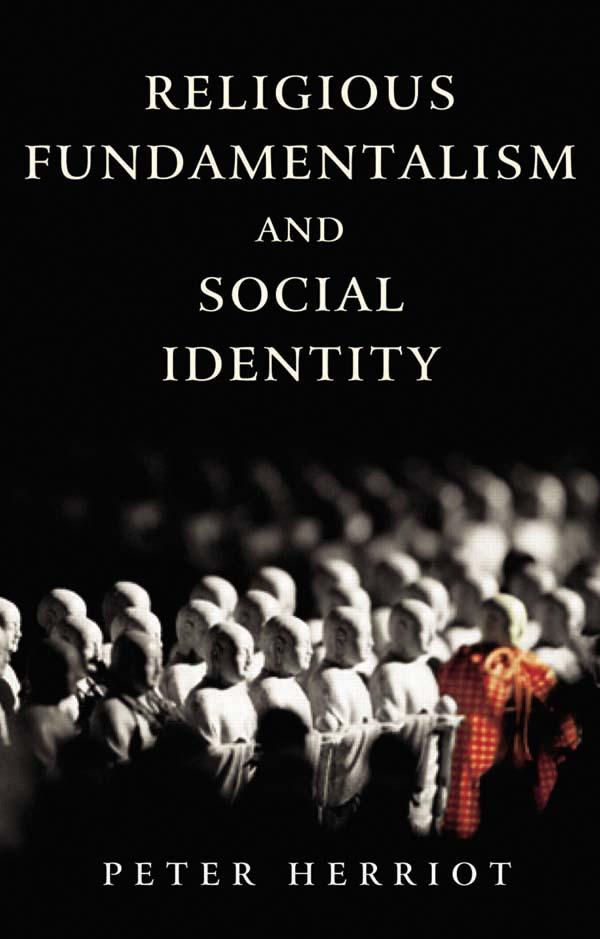
The attacks on the World Trade Centre and the Pentagon in the United States of September 11th, 2001 brought the phenomenon of religious fundamentalism to the world's attention.Sociological research has clearly demonstrated that fundamentalists are primarily reacting against modernity, and believe that they are fighting for the very survival of their faith against the secular enemy. But we understand very little about how and why people join fundamentalist movements and embrace a set of beliefs, values and norms of behaviour which are counter-cultural. This is essentially a question for social psychology, since it involves both social relations and individual selves.
Drawing on a broad theoretical perspective, social identity theory, Peter Herriot addresses two key questions: why do fundamentalists identify themselves as an in-group fighting against various out-groups? And how do the psychological needs for self-esteem and meaning motivate them? Case studies of Mohammed Atta, the leader of the 9/11 hijackers, and of the current controversy in the Anglican Church about gay priests and bishops, demonstrate how fruitfully this theory can be applied to fundamentalist conflicts. It also offers psychologically sensible ways of managing such conflicts, rather than treating fundamentalists as an enemy to be defeated.
Religious Fundamentalism and Social Identity is unique in applying social identity theory to fundamentalism, and rare in that it provides psychological (in addition to sociological) analyses of the phenomenon. It is a valuable resource for courses in social psychology which seek to demonstrate the applicability of social psychological theory to the real world.
Zahle einfach mit Karte, Klarna, Apple Pay oder Google Pay. Nicht zufrieden? Du hast immer ein 14-tägiges Widerrufsrecht. Lies mehr in unseren AGB. Hast du Fragen, schreib uns eine E-Mail an hello@memmo.org.
Memmo macht das Lernen einfacher – wo auch immer du bist. Bei uns findest du deine Kursbücher und smarte Lerntools an einem Ort: Zusammenfassungen, Quizzes, Podcasts und Lernkarten. Und Ted, dein Lernbuddy, beantwortet alles, was du wissen möchtest. Über 50.000 Studierende lernen bereits hier – gemacht, damit du schneller lernst und weniger Stress hast.