
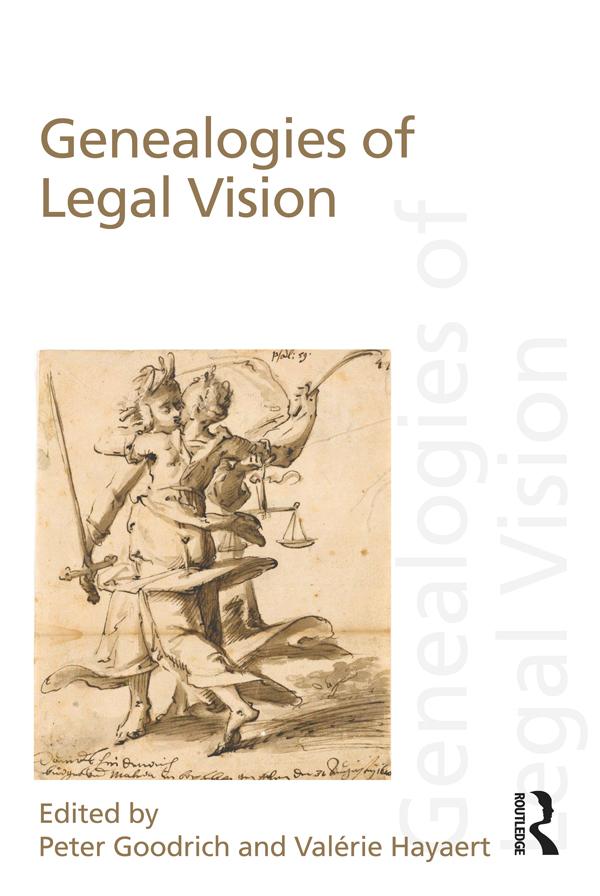
It was the classical task of legal rhetoric to make law both seen and understood. These conjoint goals came to be separated and opposed in modernity and a degree of blindness ensued. Legal reason was increasingly deemed to be a purely textual enterprise. Against this constraint and in furtherance of an incipient visual turn in legal studies, Genealogies of Legal Vision seeks to revive the classical ars iuris and to this end traces the history of regimes of visual control.
Law always relied in significant measure upon the use of visual representations, upon pictures, architecture, costume and statuary to convey authority and sovereign norm. Military, religious, administrative and legal insignia found juridical codification and expression in collections of signs of office, in heraldic codes, in genealogical devices, and then finally in the juridical invention in the mid-sixteenth century of the legal emblem book.
Genealogies of Legal Vision traces the complex lineage of the legal emblem and argues that the mens emblematica of the humanist lawyers was the inauguration of a visiocratic regime that continues into the multiple new technologies and novel media of contemporary governance. Bringing together leading experts on the history and art of legal emblems this collection provides a ground-breaking account of the long relationship between visibility, meaning and normativity.
Zahle einfach mit Karte, Klarna, Apple Pay oder Google Pay. Nicht zufrieden? Du hast immer ein 14-tägiges Widerrufsrecht. Lies mehr in unseren AGB. Hast du Fragen, schreib uns eine E-Mail an hello@memmo.org.
Memmo macht das Lernen einfacher – wo auch immer du bist. Bei uns findest du deine Kursbücher und smarte Lerntools an einem Ort: Zusammenfassungen, Quizzes, Podcasts und Lernkarten. Und Ted, dein Lernbuddy, beantwortet alles, was du wissen möchtest. Über 50.000 Studierende lernen bereits hier – gemacht, damit du schneller lernst und weniger Stress hast.