
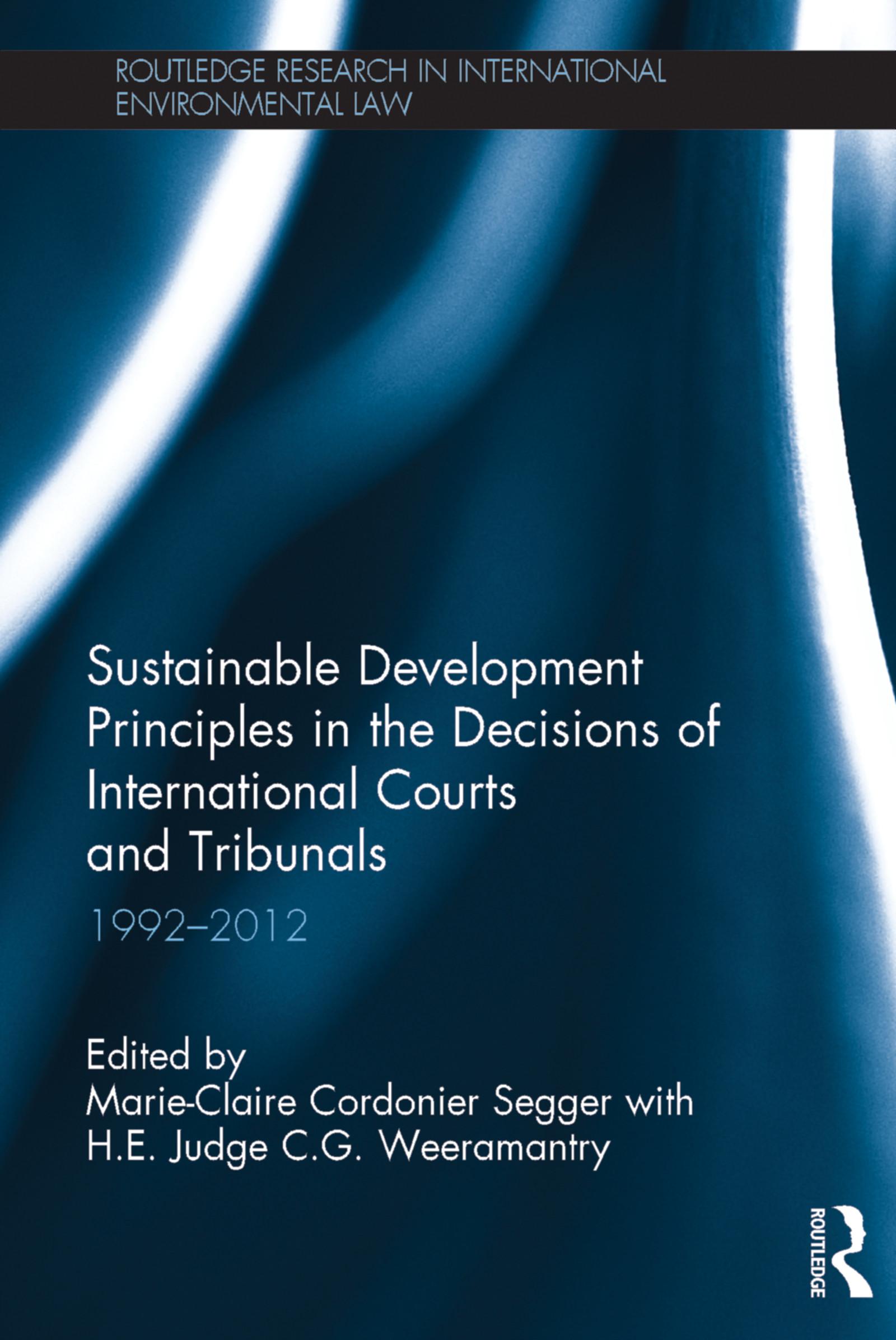
The 2002 New Delhi Declaration of Principles of International Law relating to Sustainable Development set out seven principles on sustainable development, as agreed in treaties and soft-law instruments from before the 1992 Rio ‘Earth Summit’ UNCED, to the 2002 Johannesburg World Summit on Sustainable Development, to the 2012 Rio UNCSD. Recognition of the New Delhi principles is shaping the decisions of dispute settlement bodies with jurisdiction over many subjects: the environment, human rights, trade, investment, and crime, among others.
This book explores the expanding international jurisprudence incorporating principles of international law on sustainable development. Through chapters by respected experts, the volume documents the application and interpretation of these principles, demonstrating how courts and tribunals are contributing to the world’s Sustainable Development Goals, by peacefully resolving disputes. It charts the evolution of these principles in international law from soft law standards towards recognition as customary law in certain instances, assessing key challenges to further judicial consideration of the principles, and discussing, for instance, how their relevance for compliance and disputes related to the 2015 Paris Agreement on climate change. The volume provides a unique contribution of great interest to law and policy-makers, judges, academics, students, civil society and practitioners concerned with sustainable development and the law, globally.
Zahle einfach mit Karte, Klarna, Apple Pay oder Google Pay. Nicht zufrieden? Du hast immer ein 14-tägiges Widerrufsrecht. Lies mehr in unseren AGB. Hast du Fragen, schreib uns eine E-Mail an hello@memmo.org.
Memmo macht das Lernen einfacher – wo auch immer du bist. Bei uns findest du deine Kursbücher und smarte Lerntools an einem Ort: Zusammenfassungen, Quizzes, Podcasts und Lernkarten. Und Ted, dein Lernbuddy, beantwortet alles, was du wissen möchtest. Über 50.000 Studierende lernen bereits hier – gemacht, damit du schneller lernst und weniger Stress hast.