
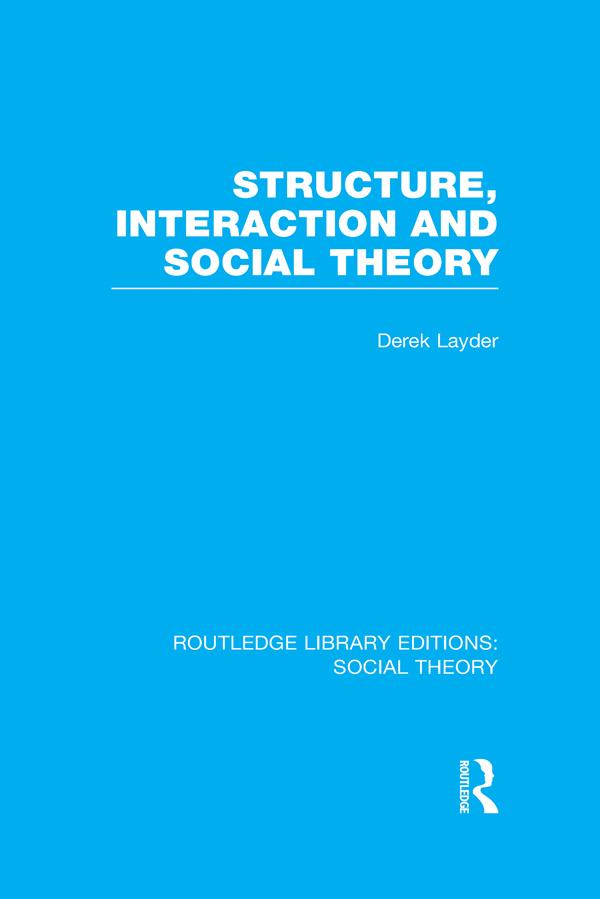
A central problem in contemporary social theory is that of providing an account of social interaction that does justice both to the self-monitoring capacities of the individuals involved and to the society that ‘frames’ the interaction. This book attempts to resolve this problem, arguing for an objectivist or ‘structuralist’ account which does not undervalue the importance of the indexical and negotiated aspects of interaction, and which takes seriously the Marxist-rationalist critique of empiricism and humanism and the associated idea that society should be treated as a supra-individual, preconstituted and constraining object of scientific analysis.
First, Dr Layder pinpoints certain of the strengths and weaknesses of various schools of thought: social psychology (scrutinized in both its sociological and psychological forms), sociology, the Marxist-rationalist approach. Whilst rejecting the mechanistic or naively deterministic theories which are often associated with an objectivist stance, he argues that the productive activities of situated actors must be understood as existing in an articulated relationship with, and within, sets of preconstituted contextual constraints. This thesis is illustrated conceptually by the development of a framework which distinguishes two types and levels of social structure, with different modes of production and reproduction, and empirically by an analysis of aspects of interaction in the occupation of acting.
Zahle einfach mit Karte, Klarna, Apple Pay oder Google Pay. Nicht zufrieden? Du hast immer ein 14-tägiges Widerrufsrecht. Lies mehr in unseren AGB. Hast du Fragen, schreib uns eine E-Mail an hello@memmo.org.
Memmo macht das Lernen einfacher – wo auch immer du bist. Bei uns findest du deine Kursbücher und smarte Lerntools an einem Ort: Zusammenfassungen, Quizzes, Podcasts und Lernkarten. Und Ted, dein Lernbuddy, beantwortet alles, was du wissen möchtest. Über 50.000 Studierende lernen bereits hier – gemacht, damit du schneller lernst und weniger Stress hast.