
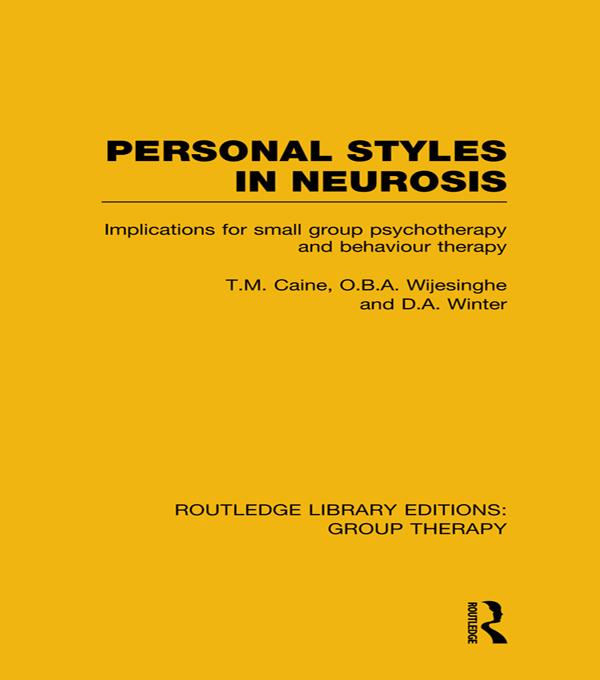
Originally published in 1981, the inadequacies of the ‘medical model’ for the understanding and psychological treatment of neuroses were widely recognized. A number of alternative approaches had arisen in response, but most of the models were theoretical, and little experimental support was documented.
One of the most pressing needs at the time was for a system of classification which could predict the behaviour of different types of neurotic patient under different treatments, and thus provide a framework for the selection of patients for small group psychotherapy and for behaviour therapy. The authors of this title develop such a framework, involving the matching of patient, therapist and treatment according to certain adjustment strategies such as ‘direction of interest’, ‘conservatism’, ‘convergent-divergent thinking’, ‘openness to inner experience’ and ‘control’. The ‘personal style’ of an individual is defined by these strategies, and by the patient’s expectations from treatment.
The authors collected a considerable amount of original research material over many years, and their evidence demonstrates the fundamental importance of ‘personal style’ in treatment allocation and response. The new approach which they propose will be of interest not only to academic psychologists but to those in the mental health professions actively engaged in psychotherapy and behaviour therapy.
Zahle einfach mit Karte, Klarna, Apple Pay oder Google Pay. Nicht zufrieden? Du hast immer ein 14-tägiges Widerrufsrecht. Lies mehr in unseren AGB. Hast du Fragen, schreib uns eine E-Mail an hello@memmo.org.
Memmo macht das Lernen einfacher – wo auch immer du bist. Bei uns findest du deine Kursbücher und smarte Lerntools an einem Ort: Zusammenfassungen, Quizzes, Podcasts und Lernkarten. Und Ted, dein Lernbuddy, beantwortet alles, was du wissen möchtest. Über 50.000 Studierende lernen bereits hier – gemacht, damit du schneller lernst und weniger Stress hast.