
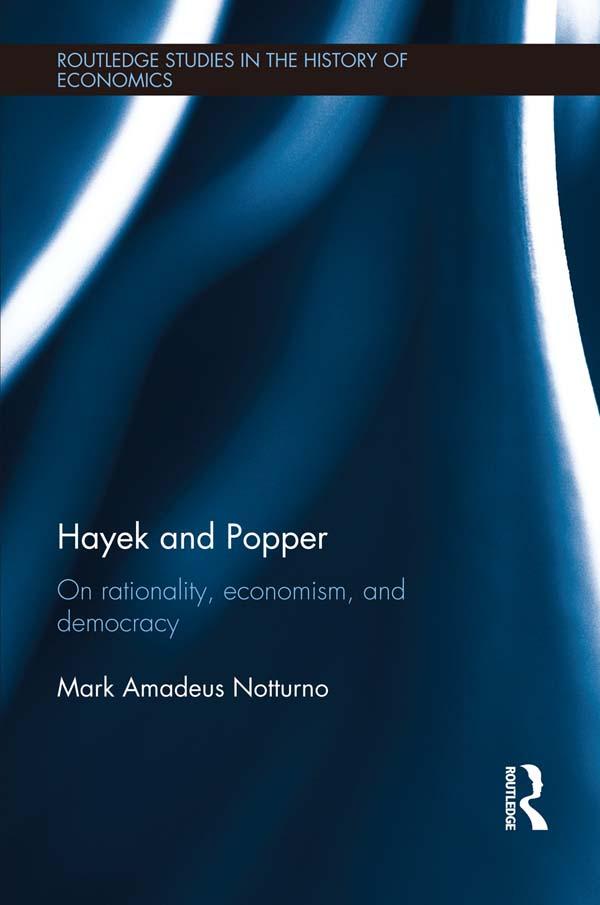
Karl Popper and Friedrich von Hayek are remembered as two of the twentieth century’s greatest proponents of open society. However, over the years, Hayek’s ideas have tended to be favoured over Popper’s in both academic and political discussions. This book aims to improve understanding of Popper’s and Hayek’s philosophies by explaining their differences, and whilst doing so, to encourage liberal political philosophers to take a better-informed and more sympathetic look at Popper’s ideas about open society.
Popper and Hayek differed in subtle but fundamental ways about rationality, economism, and democracy. They thus differed about whether and to what extent society is well served by deliberate attempts at social engineering and government intervention in the economy. They also differed about whether democracy is better served by institutions designed to elect the best leaders, or by institutions designed to protect us against the leaders we elect. And they differed, perhaps most importantly, about whether we should value freedom as a means to prosperity or an end-in-itself.
This book argues that Hayek’s views about rationality, economism, and democracy are fundamentally at odds with Popper’s¾ and perhaps even with open society itself—and that the unintended consequences of Hayek’s views may actually pose a threat to Popper’s vision of a liberal and free open society.
Zahle einfach mit Karte, Klarna, Apple Pay oder Google Pay. Nicht zufrieden? Du hast immer ein 14-tägiges Widerrufsrecht. Lies mehr in unseren AGB. Hast du Fragen, schreib uns eine E-Mail an hello@memmo.org.
Memmo macht das Lernen einfacher – wo auch immer du bist. Bei uns findest du deine Kursbücher und smarte Lerntools an einem Ort: Zusammenfassungen, Quizzes, Podcasts und Lernkarten. Und Ted, dein Lernbuddy, beantwortet alles, was du wissen möchtest. Über 50.000 Studierende lernen bereits hier – gemacht, damit du schneller lernst und weniger Stress hast.