
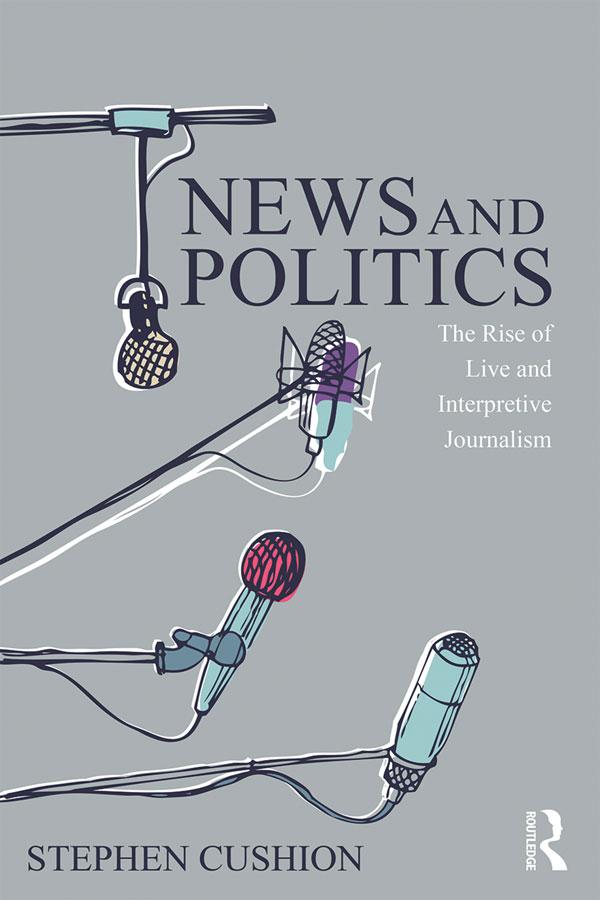
News and Politics critically examines television news bulletins – still the primary source of information for most people – and asks whether the wider pace and immediacy of 24-hour news culture has influenced their format and style over time. Drawing on the concepts of mediatization and journalistic interventionism, Stephen Cushion empirically traces the shift from edited to live reporting from a cross-national perspective, focussing on the two-way convention in political coverage and the more interpretive approach to journalism it promotes.
Challenging prevailing academic wisdom, Cushion argues that the mediatization of news does not necessarily reflect a commercial logic or a lowering of journalism standards. In particular, the rise of live two-ways can potentially enhance viewers’ understanding of public affairs – moving reporters beyond their visual backdrops and reliance on political soundbites – by asking journalists to scrutinize the actions of political elites, interpret competing source claims and to explain the broader context to everyday stories. Considering the future of 24-hour news, a final discussion asks whether new content and social media platforms – including Twitter and Buzzfeed – enhance or weaken democratic culture.
This timely analysis of News and Politics is ideal for students of political communication and journalism studies, as well as communication studies, media studies, and political science.
Zahle einfach mit Karte, Klarna, Apple Pay oder Google Pay. Nicht zufrieden? Du hast immer ein 14-tägiges Widerrufsrecht. Lies mehr in unseren AGB. Hast du Fragen, schreib uns eine E-Mail an hello@memmo.org.
Memmo macht das Lernen einfacher – wo auch immer du bist. Bei uns findest du deine Kursbücher und smarte Lerntools an einem Ort: Zusammenfassungen, Quizzes, Podcasts und Lernkarten. Und Ted, dein Lernbuddy, beantwortet alles, was du wissen möchtest. Über 50.000 Studierende lernen bereits hier – gemacht, damit du schneller lernst und weniger Stress hast.