
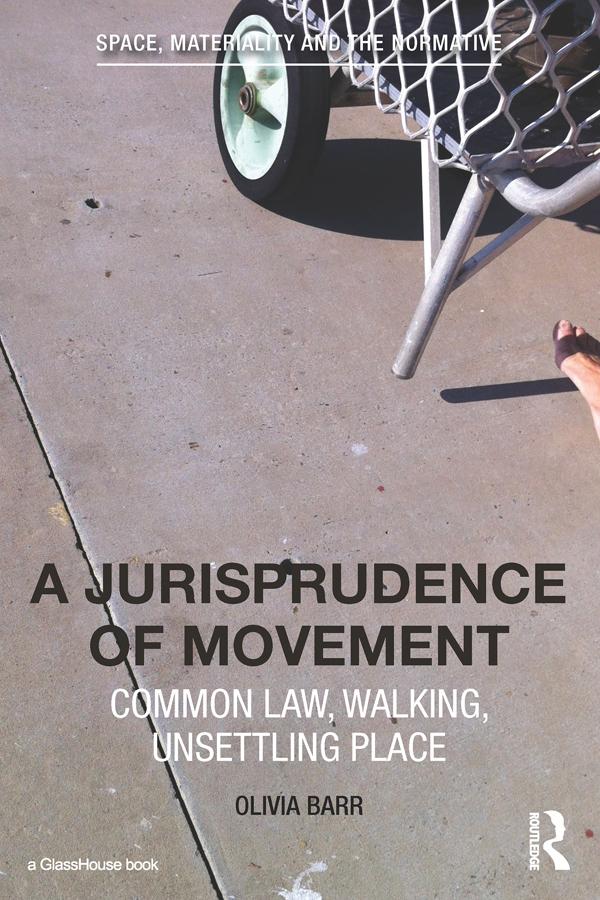
Law moves, whether we notice or not. Set amongst a spatial turn in the humanities, and jurisprudence more specifically, this book calls for a greater attention to legal movement, in both its technical and material forms. Despite various ways the spatial turn has been taken up in legal thought, questions of law, movement and its materialities are too often overlooked. This book addresses this oversight, and it does so through an attention to the materialities of legal movement. Paying attention to how law moves across different colonial and contemporary spaces, this book reveals there is a problem with common law’s place.
Primarily set in the postcolonial context of Australia – although ranging beyond this nationalised topography, both spatially and temporally – this book argues movement is fundamental to the very terms of common law’s existence. How, then, might we move well? Explored through examples of walking and burial, this book responds to the challenge of how to live with a contemporary form of colonial legal inheritance by arguing we must take seriously the challenge of living with law, and think more carefully about its spatial productions, and place-making activities. Unsettling place, this book returns the question of movement to jurisprudence.
Zahle einfach mit Karte, Klarna, Apple Pay oder Google Pay. Nicht zufrieden? Du hast immer ein 14-tägiges Widerrufsrecht. Lies mehr in unseren AGB. Hast du Fragen, schreib uns eine E-Mail an hello@memmo.org.
Memmo macht das Lernen einfacher – wo auch immer du bist. Bei uns findest du deine Kursbücher und smarte Lerntools an einem Ort: Zusammenfassungen, Quizzes, Podcasts und Lernkarten. Und Ted, dein Lernbuddy, beantwortet alles, was du wissen möchtest. Über 50.000 Studierende lernen bereits hier – gemacht, damit du schneller lernst und weniger Stress hast.