
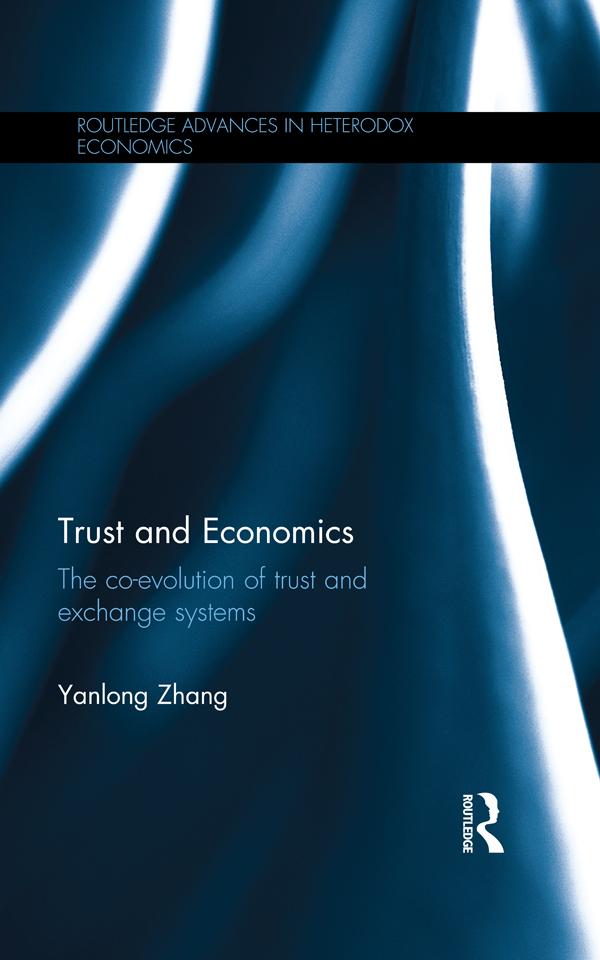
A lot of recent attention has been given to one of the central paradoxes of trust: namely how people can restrict self-interest in order to trust. Existing perspectives, theories, and models offer partial explanations, but this volume presents a novel framework that expands on the findings of recent studies of trust and exchange. This book offers a new angle for the understanding of exchange and trust in an interactive context, describes the interactive characteristics of trust in exchange systems, and develops a theory explaining the co-evolution of trust and exchange systems.
A new framework is used to incorporate the theory of systems of trust and evolutionary game-theoretical approach to investigate four important questions: How can trust emerge in exchange when people pursue self-interest? After its emergence, how does exchange affect trust in a dynamic process? When are dynamics of trust stable? Do interactive trust phenomena differ under different exchange systems? This book concludes with a discussion of the implications of the theoretical findings for three areas: the improvement of trust, potential economic growth, and mechanism design in exchange systems.
This volume makes a significant contribution to the literature on evolutionary and institutional economics and is suitable for those who have an interest in political economy, economy theory and philosophy as well as economic psychology.
Zahle einfach mit Karte, Klarna, Apple Pay oder Google Pay. Nicht zufrieden? Du hast immer ein 14-tägiges Widerrufsrecht. Lies mehr in unseren AGB. Hast du Fragen, schreib uns eine E-Mail an hello@memmo.org.
Memmo macht das Lernen einfacher – wo auch immer du bist. Bei uns findest du deine Kursbücher und smarte Lerntools an einem Ort: Zusammenfassungen, Quizzes, Podcasts und Lernkarten. Und Ted, dein Lernbuddy, beantwortet alles, was du wissen möchtest. Über 50.000 Studierende lernen bereits hier – gemacht, damit du schneller lernst und weniger Stress hast.