
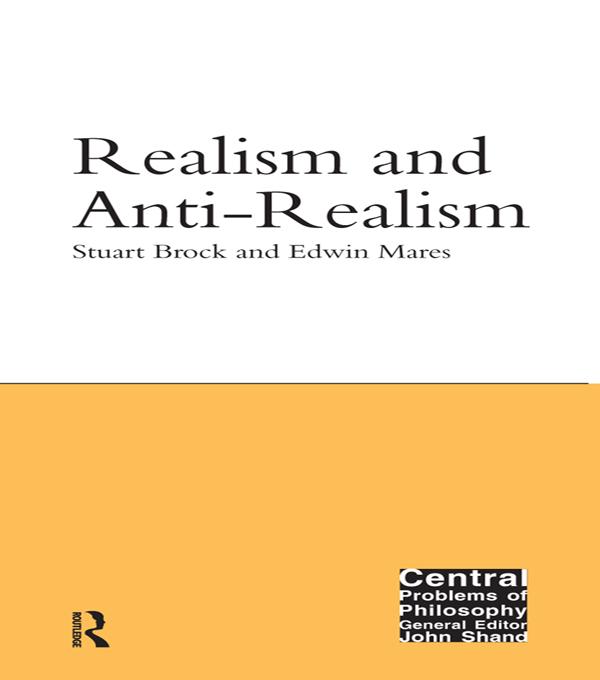
There are a bewildering variety of ways the terms "realism" and "anti-realism" have been used in philosophy and furthermore the different uses of these terms are only loosely connected with one another. Rather than give a piecemeal map of this very diverse landscape, the authors focus on what they see as the core concept: realism about a particular domain is the view that there are facts or entities distinctive of that domain, and their existence and nature is in some important sense objective and mind-independent. The authors carefully set out and explain the different realist and anti-realist positions and arguments that occur in five key domains: science, ethics, mathematics, modality and fictional objects. For each area the authors examine the various styles of argument in support of and against realism and anti-realism, show how these different positions and arguments arise in very different domains, evaluate their success within these fields, and draw general conclusions about these assorted strategies. Error theory, fictionalism, non-cognitivism, relativism and response-dependence are taken as the most important positions in opposition to the realist and these are explored in depth. Suitable for advanced level undergraduates, the book offers readers a clear introduction to a subject central to much contemporary work in metaphysics, epistemology and philosophy of language.
Zahle einfach mit Karte, Klarna, Apple Pay oder Google Pay. Nicht zufrieden? Du hast immer ein 14-tägiges Widerrufsrecht. Lies mehr in unseren AGB. Hast du Fragen, schreib uns eine E-Mail an hello@memmo.org.
Memmo macht das Lernen einfacher – wo auch immer du bist. Bei uns findest du deine Kursbücher und smarte Lerntools an einem Ort: Zusammenfassungen, Quizzes, Podcasts und Lernkarten. Und Ted, dein Lernbuddy, beantwortet alles, was du wissen möchtest. Über 50.000 Studierende lernen bereits hier – gemacht, damit du schneller lernst und weniger Stress hast.
Das könnte dir auch gefallen
Buch kaufen0