
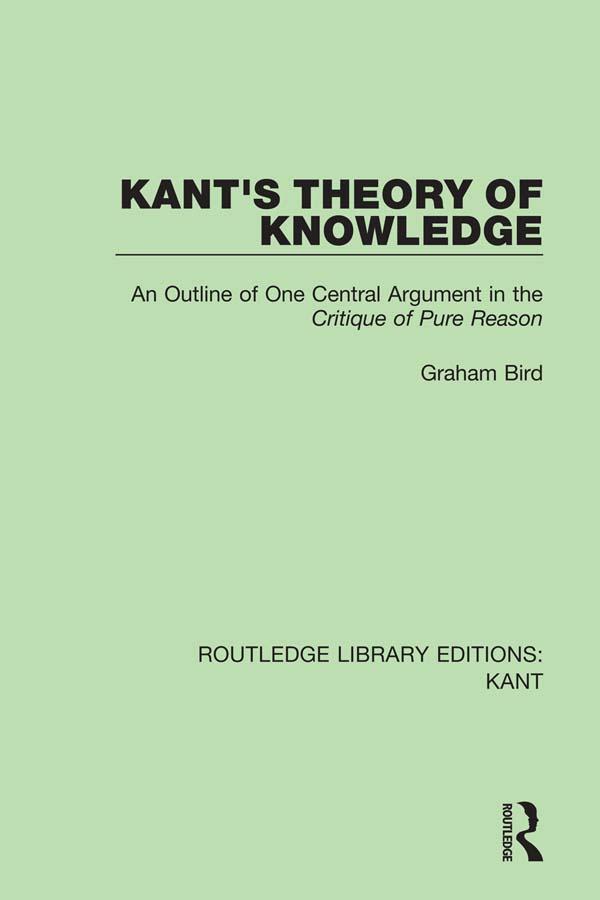
First published in 1962. Kant’s philosophical works, and especially the Critique of Pure Reason, have had some influence on recent British philosophy. But the complexities of Kant’s arguments, and the unfamiliarity of his vocabulary, inhibit understanding of his point of view. In Kant’s Theory of Knowledge an attempt is made to relate Kant’s arguments in the Critique of Pure Reason to contemporary issues by expressing them in a more modern idiom.
The selection of issues discussed is intended to present a continuous argument, of an epistemological kind, which runs centrally through the Critique. The argument deals with essentially with the problems, raised in the Transcendental Analytic, about the status of categories. It deals with certain preliminary assumptions made in setting these problems, and discusses the way in which the various sections of the Analytic contribute to their solution. It also deals with Kant’s criticisms of traditional metaphysics, and ends with an account of his effort in the Third Antinomy to resolve the conflict between freedom and causality, and so to effect a transition of knowledge to moral philosophy.
Zahle einfach mit Karte, Klarna, Apple Pay oder Google Pay. Nicht zufrieden? Du hast immer ein 14-tägiges Widerrufsrecht. Lies mehr in unseren AGB. Hast du Fragen, schreib uns eine E-Mail an hello@memmo.org.
Memmo macht das Lernen einfacher – wo auch immer du bist. Bei uns findest du deine Kursbücher und smarte Lerntools an einem Ort: Zusammenfassungen, Quizzes, Podcasts und Lernkarten. Und Ted, dein Lernbuddy, beantwortet alles, was du wissen möchtest. Über 50.000 Studierende lernen bereits hier – gemacht, damit du schneller lernst und weniger Stress hast.