
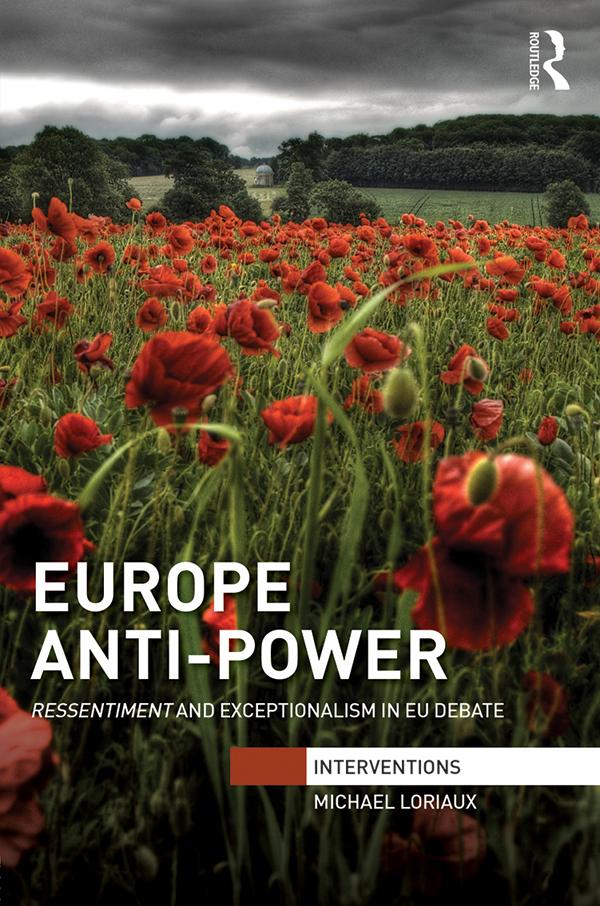
The EU seeks to define a role for itself in power politics while remaining firm in its rejection of power politics. In order to make power compatible with the European project, EU debate has appended a number of progressive adjectives to the word "power," adjectives like "civilian" and "normative," among others. This book asks what is power, such that it can be modified, tamed, and modulated by adjectives, yet remain "powerful"?
Loriaux passes EU debate on power through the mill of phenomenological and post-phenomenological analysis, juxtaposing it against writings by Machiavelli, Agamben, Thucydides, Nietzsche, Patocka, and Levinas. The book locates power in "power/play," the theatrical, staged representation of threat that generates aesthetic effect and undecidability. Power/play endows the word "power" with perlocutionary force, which the adjectives of EU "qualified" power actually enhance rather than moderate. Loriaux argues that EU discourse on power therefore risks inviting EU "exceptionalism," or risks lapsing into an expression of EU ressentiment, rather than advancing a new, progressive understanding of "power." If European Union is to remain steadfast in its opposition to power politics, it must represent itself as "anti-power."
This book will be of interest to those who work in the area of EU foreign policy, as well as to those who have a more general theoretical interest in the concept of power.
Zahle einfach mit Karte, Klarna, Apple Pay oder Google Pay. Nicht zufrieden? Du hast immer ein 14-tägiges Widerrufsrecht. Lies mehr in unseren AGB. Hast du Fragen, schreib uns eine E-Mail an hello@memmo.org.
Memmo macht das Lernen einfacher – wo auch immer du bist. Bei uns findest du deine Kursbücher und smarte Lerntools an einem Ort: Zusammenfassungen, Quizzes, Podcasts und Lernkarten. Und Ted, dein Lernbuddy, beantwortet alles, was du wissen möchtest. Über 50.000 Studierende lernen bereits hier – gemacht, damit du schneller lernst und weniger Stress hast.