
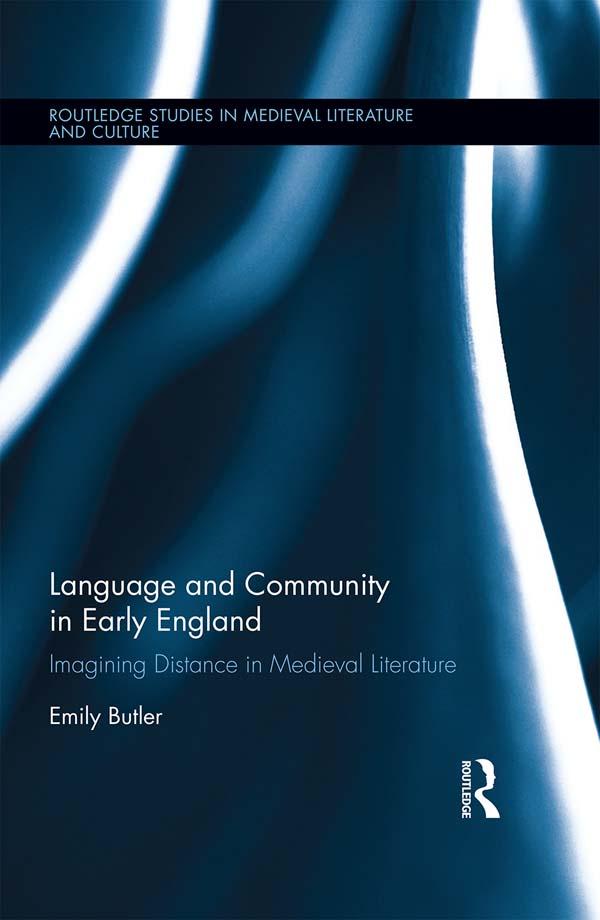
This book examines the development of English as a written vernacular and identifies that development as a process of community building that occurred in a multilingual context. Moving through the eighth century to the thirteenth century, and finally to the sixteenth-century antiquarians who collected medieval manuscripts, it suggests that this important period in the history of English can only be understood if we loosen our insistence on a sharp divide between Old and Middle English and place the textuality of this period in the framework of a multilingual matrix. The book examines a wide range of materials, including the works of Bede, the Alfredian circle, and Wulfstan, as well as the mid-eleventh-century Encomium Emmae Reginae, the Tremulous Hand of Worcester, the Ancrene Wisse, and Matthew Parker’s study of Old English manuscripts. Engaging foundational theories of textual community and intellectual community, this book provides a crucial link with linguistic distance. Perceptions of distance, whether between English and other languages or between different forms of English, are fundamental to the formation of textual community, since the awareness of shared language that can shape or reinforce a sense of communal identity only has meaning by contrast with other languages or varieties. The book argues that the precocious rise of English as a written vernacular has its basis in precisely these communal negotiations of linguistic distance, the effects of which were still playing out in the religious and political upheavals of the sixteenth century. Ultimately, the book argues that the tension of linguistic distance provides the necessary energy for the community-building activities of annotation and glossing, translation, compilation, and other uses of texts and manuscripts. This will be an important volume for literary scholars of the medieval period, and those working on the early modern period, both on literary topics and on historical studies of English nationalism. It will also appeal to those with interests in sociolinguistics, history of the English language, and medieval religious history.
Zahle einfach mit Karte, Klarna, Apple Pay oder Google Pay. Nicht zufrieden? Du hast immer ein 14-tägiges Widerrufsrecht. Lies mehr in unseren AGB. Hast du Fragen, schreib uns eine E-Mail an hello@memmo.org.
Memmo macht das Lernen einfacher – wo auch immer du bist. Bei uns findest du deine Kursbücher und smarte Lerntools an einem Ort: Zusammenfassungen, Quizzes, Podcasts und Lernkarten. Und Ted, dein Lernbuddy, beantwortet alles, was du wissen möchtest. Über 50.000 Studierende lernen bereits hier – gemacht, damit du schneller lernst und weniger Stress hast.