
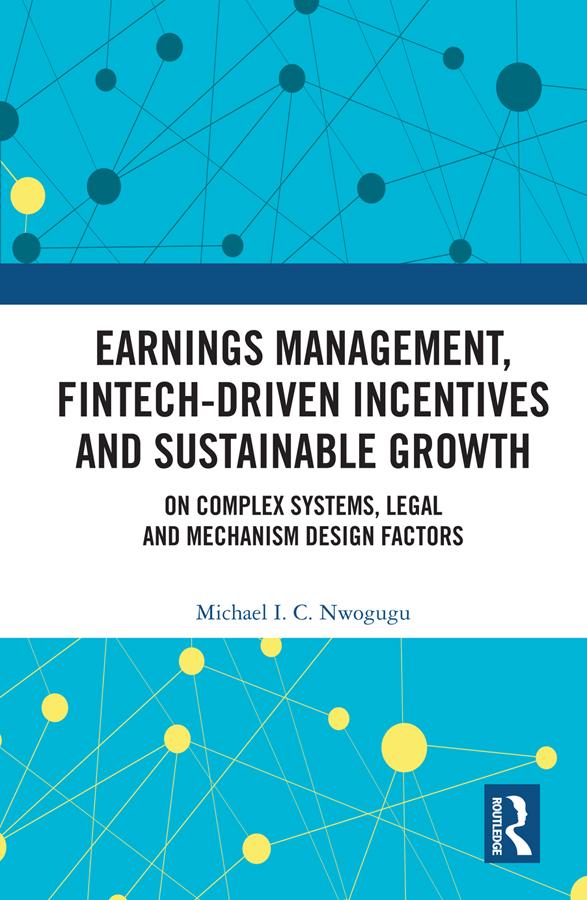
Traditional research about Financial Stability and Sustainable Growth typically omits Earnings Management (as a broad class of misconduct), Complex Systems Theory, Mechanism Design Theory, Public Health, psychology issues, and the externalities and psychological effects of Fintech. Inequality, Environmental Pollution, Earnings Management opportunities, the varieties of complex Financial Instruments, Fintech, Regulatory Fragmentation, Regulatory Capture and real-financial sector-linkages are growing around the world, and these factors can have symbiotic relationships. Within Complex System theory framework, this book analyzes these foregoing issues, and introduces new behaviour theories, Enforcement Dichotomies, and critiques of models, regulations and theories in several dimensions. The issues analyzed can affect markets, and evolutions of systems, decision-making, "nternal Markets and risk-perception within government regulators, operating companies and investment entities, and thus they have Public Policy implications. The legal analysis uses applicable US case-law and statutes (which have been copied by many countries, and are similar to those of many common-law countries).
Using Qualitative Reasoning, Capital Dynamics Theory (a new approach introduced in this book), Critical Theory and elements of Mechanism Design Theory, the book aims to enhance cross-disciplinary analysis of the above-mentioned issues; and to help researchers build better systems/Artificial-Intelligence/mathematical models in Financial Stability, Portfolio Management, Policy-Analysis, Asset Pricing, Contract Theory, Enforcement Theory and Fraud Detection.
The primary audience for this book consists of university Professors, PHD students and PHD degree-holders (in industries, government agencies, financial services companies and research institutes). The book can be used as a primary or supplementary textbook for graduate courses in Regulation; Capital Markets; Law & Economics, International Political Economy and or Mechanism Design (Applied Math, Operations Research, Computer Science or Finance).
Zahle einfach mit Karte, Klarna, Apple Pay oder Google Pay. Nicht zufrieden? Du hast immer ein 14-tägiges Widerrufsrecht. Lies mehr in unseren AGB. Hast du Fragen, schreib uns eine E-Mail an hello@memmo.org.
Memmo macht das Lernen einfacher – wo auch immer du bist. Bei uns findest du deine Kursbücher und smarte Lerntools an einem Ort: Zusammenfassungen, Quizzes, Podcasts und Lernkarten. Und Ted, dein Lernbuddy, beantwortet alles, was du wissen möchtest. Über 50.000 Studierende lernen bereits hier – gemacht, damit du schneller lernst und weniger Stress hast.