
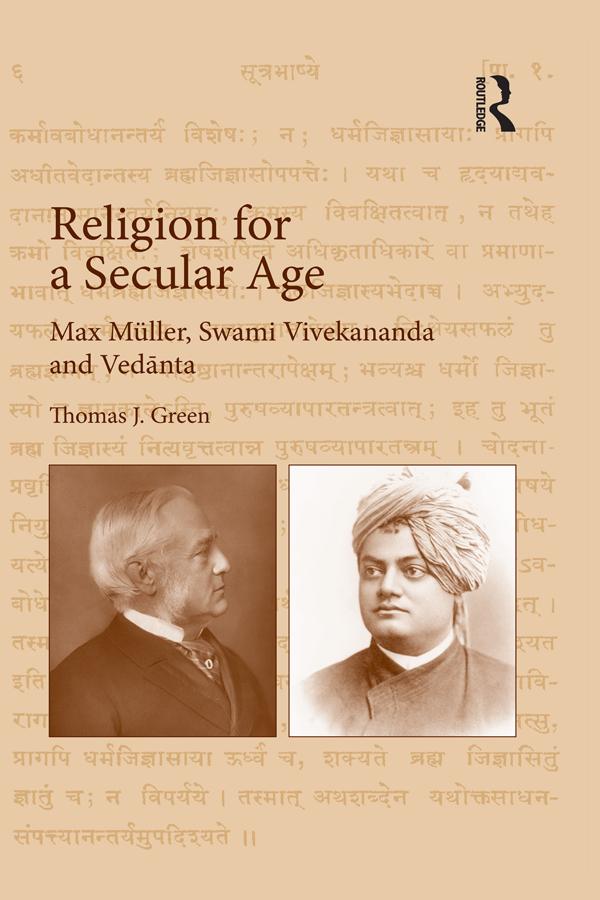
Religion for a Secular Age provides a transnational history of modern Vedānta through a comparative study of two of its most important exponents, Friedrich Max Muller (1823–1900) and Swami Vivekananda (1863–1902). This book explains why Vedānta's appeal spanned the ostensibly very different contexts of colonial India and Victorian Britain and America, and how this ancient form of thought was translated by Muller and Vivekananda into a modern form of philosophy or religion. These religiously-committed men attempted to reconcile religion with modernity by appealing to Advaita (literally, 'non-dualistic') Vedānta's monistic interpretation of reality. The 'scientific' study of religion allegedly demonstrated the evolutionary superiority of Vedānta and the possibility of religion's survival in 'the light of modern science'. They believed Vedānta could also provide the religious basis for moral engagement in this world, even as the hold of orthodox Christianity and traditional Hinduism appeared to be weakening. Vedānta thus served as a way of articulating a form of religion suitable for a secular age – religion which has embraced modern forms of thought while breaking away from creeds, scriptures and institutions to thrive in the spheres of public debate of London, Calcutta and New York.
Zahle einfach mit Karte, Klarna, Apple Pay oder Google Pay. Nicht zufrieden? Du hast immer ein 14-tägiges Widerrufsrecht. Lies mehr in unseren AGB. Hast du Fragen, schreib uns eine E-Mail an hello@memmo.org.
Memmo macht das Lernen einfacher – wo auch immer du bist. Bei uns findest du deine Kursbücher und smarte Lerntools an einem Ort: Zusammenfassungen, Quizzes, Podcasts und Lernkarten. Und Ted, dein Lernbuddy, beantwortet alles, was du wissen möchtest. Über 50.000 Studierende lernen bereits hier – gemacht, damit du schneller lernst und weniger Stress hast.