
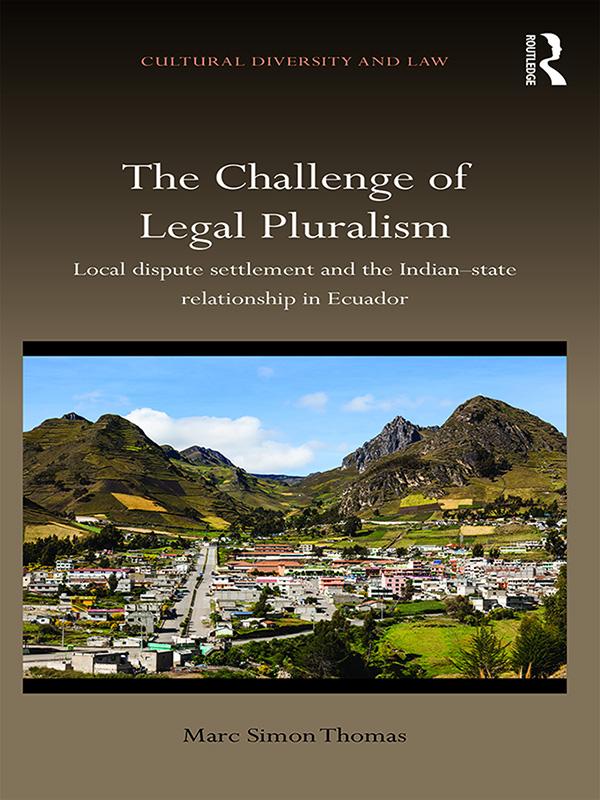
Within the Latin American context, legal pluralism is often depicted as a dichotomy between customary law and national law. In addition, the use of customary law alongside national law is frequently portrayed as a vehicle of resistance.
This book argues that, because ordinary Indians are not positively biased in favor of customary law per se, a heterogeneity of legal practices can be observed on a daily basis, which consequently undermines the commonly held view of customary law as a "counter-hegemonic strategy", even if, on other socio-geographical levels, this thinking in terms of resistance holds true. Based on qualitative research, the work analyzes how internal conflicts among indigenous inhabitants of the Ecuadorian highlands are being settled in a situation of formal legal pluralism, and what can be learned from this in terms of Indian-state relationships. It is shown that, on a local level, the phenomenological dimension of legal pluralism can be termed "interlegality." On a macro level, ontological assumptions underscore that legal pluralism is still seen as a dichotomy between customary and national law.
Multidisciplinary in nature, the book will be of interest to academics and researchers working in the areas of Legal Pluralism, Cultural Anthropology and Latin American Studies.
Zahle einfach mit Karte, Klarna, Apple Pay oder Google Pay. Nicht zufrieden? Du hast immer ein 14-tägiges Widerrufsrecht. Lies mehr in unseren AGB. Hast du Fragen, schreib uns eine E-Mail an hello@memmo.org.
Memmo macht das Lernen einfacher – wo auch immer du bist. Bei uns findest du deine Kursbücher und smarte Lerntools an einem Ort: Zusammenfassungen, Quizzes, Podcasts und Lernkarten. Und Ted, dein Lernbuddy, beantwortet alles, was du wissen möchtest. Über 50.000 Studierende lernen bereits hier – gemacht, damit du schneller lernst und weniger Stress hast.