
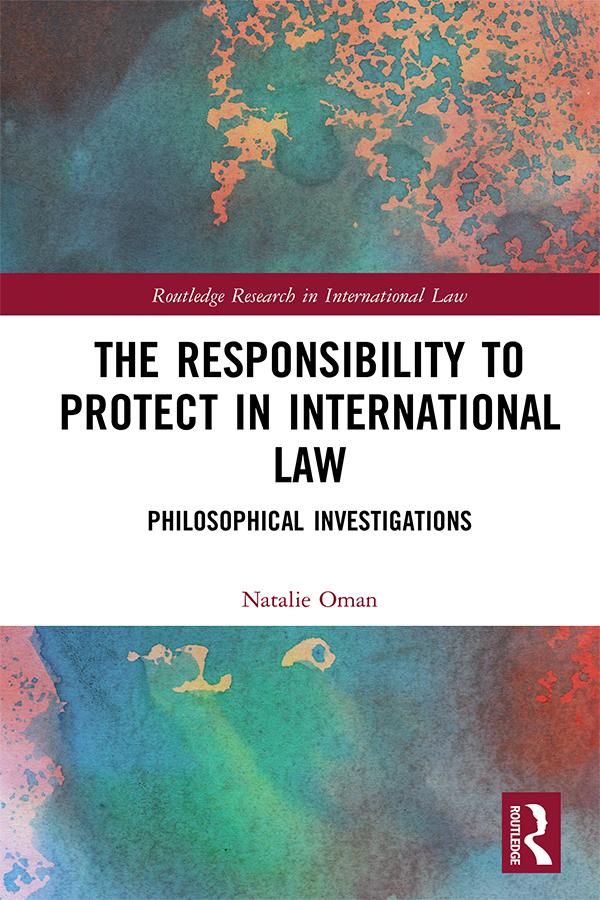
This book tracks the development of the emerging international legal principle of a responsibility to protect over the past two decades. It contrasts the influential version of the principle introduced by the International Commission on Intervention and State Sovereignty in 2001 with subsequent interpretations of the responsibility to protect advocated by the United Nations through its human protection agenda, and reviews the dangers and inconsistencies inherent in both perspectives. The author demonstrates that the evolving responsibility to protect principle can be recruited to support a wide range of irreconcilable projects, from those of cosmopolitan constitutionalism to those of hegemonic international law. However, despite the dangers posed by this susceptibility to conceptual hijacking, Oman argues that the responsibility to protect, like human rights, is an essential a modern emancipatory formation. To remedy this dangerous malleability, the author advocates a third, distinctive interpretation of the responsibility to protect designed to limit its cooptation by liberal anti-pluralist and hegemonic international law agendas. Oman outlines the key features of such a minimalist conception, and explores its fit with the "RtoP" version of the responsibility to protect promoted in recent years by the UN. The author argues that two crucial features missing from the UN reading of the principle should be developed in future: an acknowledgement of the role of non-state actors as bearers of the responsibility to protect, and a recognition of the principle's legal character. Both of these aspects of the principle offer means to democratize the international law-making enterprise.
Zahle einfach mit Karte, Klarna, Apple Pay oder Google Pay. Nicht zufrieden? Du hast immer ein 14-tägiges Widerrufsrecht. Lies mehr in unseren AGB. Hast du Fragen, schreib uns eine E-Mail an hello@memmo.org.
Memmo macht das Lernen einfacher – wo auch immer du bist. Bei uns findest du deine Kursbücher und smarte Lerntools an einem Ort: Zusammenfassungen, Quizzes, Podcasts und Lernkarten. Und Ted, dein Lernbuddy, beantwortet alles, was du wissen möchtest. Über 50.000 Studierende lernen bereits hier – gemacht, damit du schneller lernst und weniger Stress hast.