
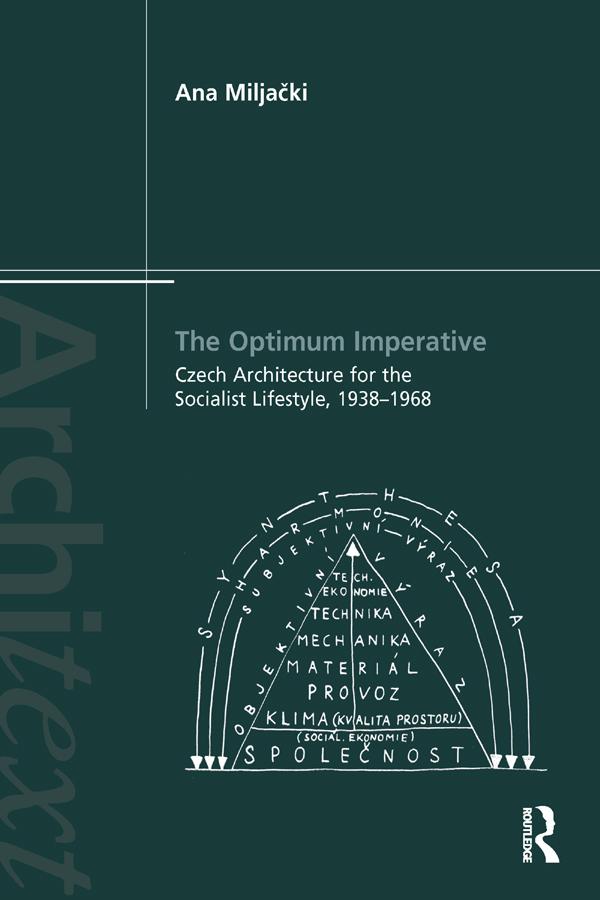
The Optimum Imperative examines architecture’s multiple entanglements within the problematics of Socialist lifestyle in postwar Czechoslovakia.
Situated in the period loosely bracketed by the signing of the Munich accords in 1938, which affected Czechoslovakia’s entrance into World War II, and the Warsaw Pact troops’ occupation of Prague in 1968, the book investigates three decades of Czech architecture, highlighting a diverse cast of protagonists. Key among them are the theorist and architect Karel Honzík and a small group of his colleagues in the Club for the Study of Consumption; the award-winning Czechoslovak Pavilion at the 1958 World Expo in Brussels; and SIAL, a group of architects from Liberec that emerged from the national network of Stavoprojekt offices during the reform years, only to be subsumed back into it in the wake of Czechoslovak normalization. This episodic approach enables a long view of the way that the project of constructing Socialism was made disciplinarily specific for architecture, through the constant interpretation of Socialist lifestyle, both as a narrative framework and as a historical goal.
Without sanitizing history of its absurd contortions in discourse and in daily life, the book takes as its subject the complex and dynamic relationships between Cold War politics, state power, disciplinary legitimating narratives, and Czech architects’ optimism for Socialism. It proposes that these key dimensions of practicing architecture and building Socialism were intertwined, and even commensurate at times, through the framework of Socialist lifestyle.
Zahle einfach mit Karte, Klarna, Apple Pay oder Google Pay. Nicht zufrieden? Du hast immer ein 14-tägiges Widerrufsrecht. Lies mehr in unseren AGB. Hast du Fragen, schreib uns eine E-Mail an hello@memmo.org.
Memmo macht das Lernen einfacher – wo auch immer du bist. Bei uns findest du deine Kursbücher und smarte Lerntools an einem Ort: Zusammenfassungen, Quizzes, Podcasts und Lernkarten. Und Ted, dein Lernbuddy, beantwortet alles, was du wissen möchtest. Über 50.000 Studierende lernen bereits hier – gemacht, damit du schneller lernst und weniger Stress hast.