
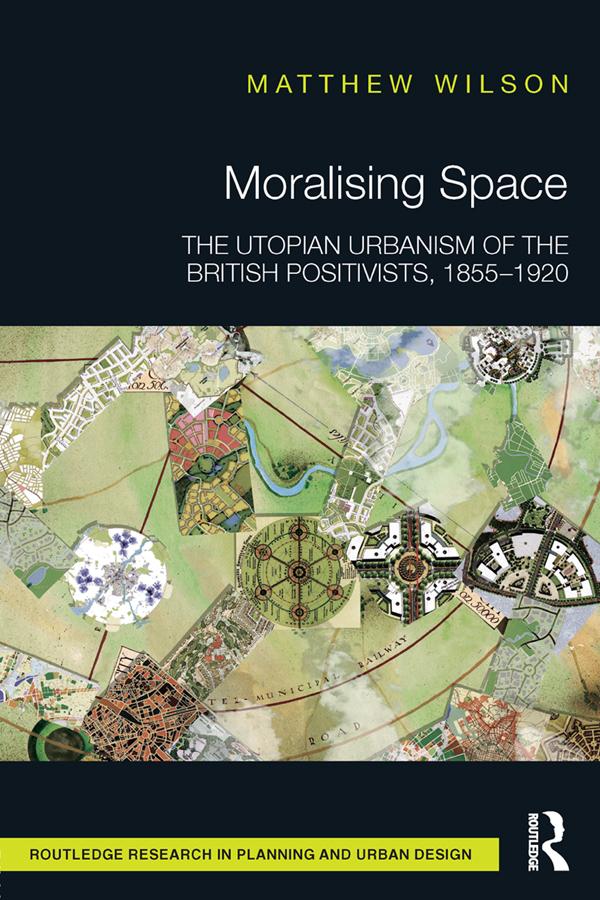
Amidst the soot, stink and splendour of Victorian London, a coterie of citizen-sociologists set out to break up the British Empire. They were the followers of the French philosopher Auguste Comte, a controversial figure who introduced the modern science of sociology and the republican Religion of Humanity. Moralising Space examines how from the 1850s Comte’s British followers practised this science and religion with the aim to create a global network of 500 utopian city-states.
Curiously the British Positivists’ work has never been the focus of a full-length study on modern sociology and town planning. In this intellectual history, Matthew Wilson shows that through to the interwar period affiliates to the British Positivist Society – Richard Congreve, Frederic Harrison, Charles Booth, Patrick Geddes and Victor Branford – attempted to realise Comte’s vision. With scarcely used source material Wilson presents the Positivists as an organised resistance to imperialism, industrial exploitation, poverty and despondency. Much to the consternation of the church, state and landed aristocracy they organised urban interventions, led ad hoc sociological surveys and published programmes for realising idyllic city-communities. Effectively this book contributes to our understanding of how Positivism, as a utopian spatial design praxis, heavily influenced twentieth-century architecture and planning.
Zahle einfach mit Karte, Klarna, Apple Pay oder Google Pay. Nicht zufrieden? Du hast immer ein 14-tägiges Widerrufsrecht. Lies mehr in unseren AGB. Hast du Fragen, schreib uns eine E-Mail an hello@memmo.org.
Memmo macht das Lernen einfacher – wo auch immer du bist. Bei uns findest du deine Kursbücher und smarte Lerntools an einem Ort: Zusammenfassungen, Quizzes, Podcasts und Lernkarten. Und Ted, dein Lernbuddy, beantwortet alles, was du wissen möchtest. Über 50.000 Studierende lernen bereits hier – gemacht, damit du schneller lernst und weniger Stress hast.