
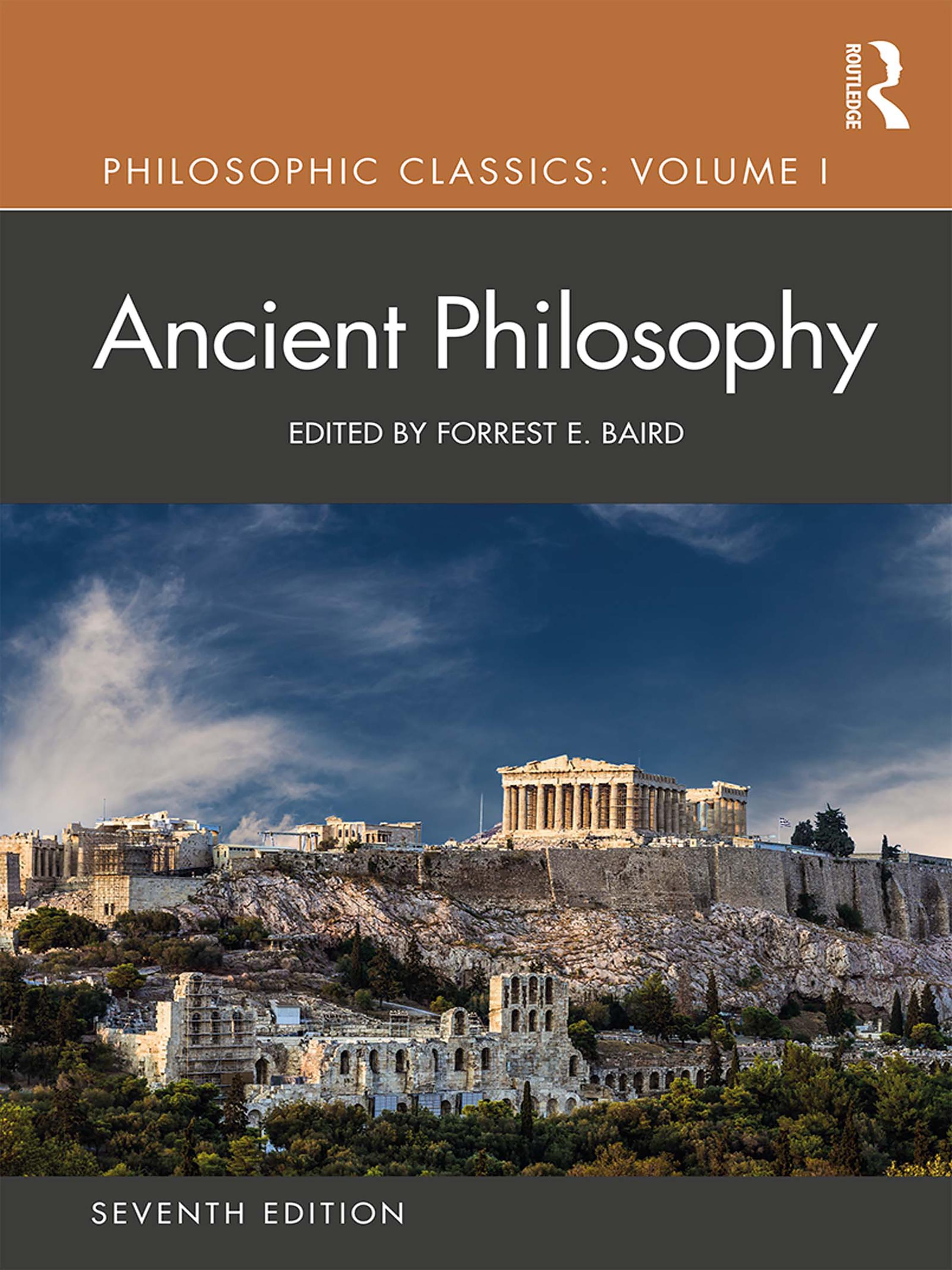
This seventh edition of Philosophic Classics, Volume I: Ancient Philosophy includes essential writings of the most important Greek philosophers, along with selections from some of their Roman followers. In updating this edition, editor Forrest E. Baird has continued to follow the same criteria established by the late Walter Kaufmann when the Philosophic Classics series was first established: (1) to use complete works or, where more appropriate, complete sections of works (2) in clear translations (3) of texts central to the thinker’s philosophy or widely accepted as part of the "canon." To make the works more accessible to students, most footnotes treating textual matters (variant readings, etc.) have been omitted and important Greek words have been transliterated and put in angle brackets. In addition, each thinker is introduced by a brief essay composed of three sections: (1) biographical (a glimpse of the life), (2) philosophical (a résumé of the philosopher’s thought), and (3) bibliographical (suggestions for further reading).
New to this seventh edition:
Changes in translations:
New translations of Plato’s Apology and Phaedo and Aristotle’s Nichomachean Ethics and Politics from the acclaimed Focus Philosophical Library Series.
New translations of Plato’s Euthyphro and Crito.
New translations of Epicurus’s Letter to Herodotus, Letter to Menoeceus, and Principal Doctrines.
New translation of the Parmenides fragments.
Additional material:
Gorgias’s model oration, Encomium on Helen, which gives a defense of Helen of Troy.
A selection from Plato’s Gorgias on nature <physis> versus convention or law <nomos>.
Additional material from the opening of Plato’s Symposium to contextualize the dialogue.
Additional material from Plato’s Republic (Book IX) on the tri-partite soul.
Additional material from Aristotle’s Metaphysics (Book IV, 1-4, 7) on the nature of being and the so-called "three rules of thought."
A brief selection from Porphyry’s Life of Plotinus, giving a sense of the person.
Updated and reorganized bibliographies.
To allow for all these changes, a section of Book V from Plato’s Republic has been dropped.
Those who use this first volume in a one-term course in ancient philosophy will find more material here than can easily fit a normal semester. But this embarrassment of riches gives teachers some choice and, for those who offer the same course year after year, an opportunity to change the menu.
Zahle einfach mit Karte, Klarna, Apple Pay oder Google Pay. Nicht zufrieden? Du hast immer ein 14-tägiges Widerrufsrecht. Lies mehr in unseren AGB. Hast du Fragen, schreib uns eine E-Mail an hello@memmo.org.
Memmo macht das Lernen einfacher – wo auch immer du bist. Bei uns findest du deine Kursbücher und smarte Lerntools an einem Ort: Zusammenfassungen, Quizzes, Podcasts und Lernkarten. Und Ted, dein Lernbuddy, beantwortet alles, was du wissen möchtest. Über 50.000 Studierende lernen bereits hier – gemacht, damit du schneller lernst und weniger Stress hast.