
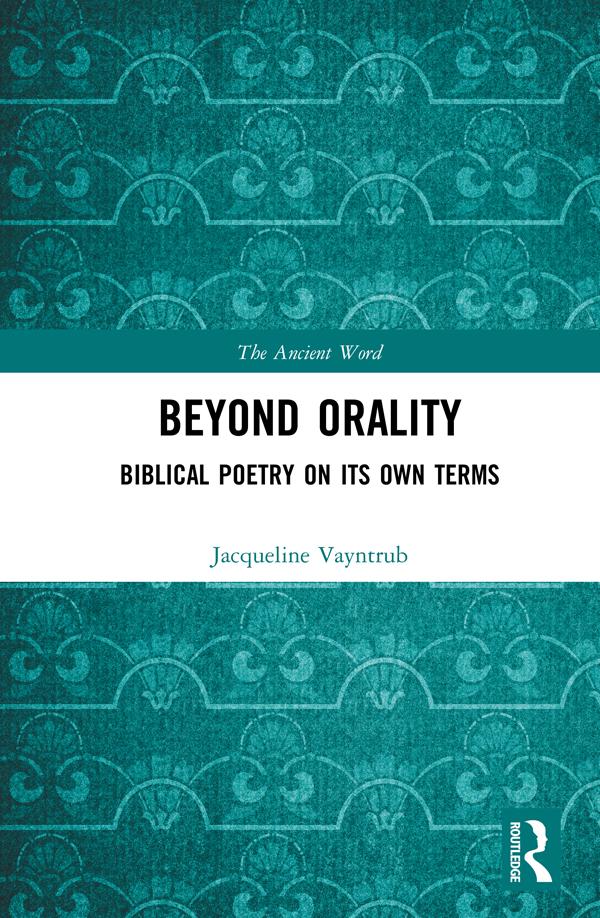
Central to understanding the prophecy and prayer of the Hebrew Bible are the unspoken assumptions that shaped them—their genres. Modern scholars describe these works as “poetry,” but there was no corresponding ancient Hebrew term or concept. Scholars also typically assume it began as “oral literature,” a concept based more in evolutionist assumptions than evidence. Is biblical poetry a purely modern fiction, or is there a more fundamental reason why its definition escapes us?
Beyond Orality: Biblical Poetry on its Own Terms changes the debate by showing how biblical poetry has worked as a mirror, reflecting each era’s own self-image of verbal art. Yet Vayntrub also shows that this problem is rooted in a crucial pattern within the Bible itself: the texts we recognize as “poetry” are framed as powerful and ancient verbal performances, dramatic speeches from the past. The Bible’s creators presented what we call poetry in terms of their own image of the ancient and the oral, and understanding their native theories of Hebrew verbal art gives us a new basis to rethink our own.
Zahle einfach mit Karte, Klarna, Apple Pay oder Google Pay. Nicht zufrieden? Du hast immer ein 14-tägiges Widerrufsrecht. Lies mehr in unseren AGB. Hast du Fragen, schreib uns eine E-Mail an hello@memmo.org.
Memmo macht das Lernen einfacher – wo auch immer du bist. Bei uns findest du deine Kursbücher und smarte Lerntools an einem Ort: Zusammenfassungen, Quizzes, Podcasts und Lernkarten. Und Ted, dein Lernbuddy, beantwortet alles, was du wissen möchtest. Über 50.000 Studierende lernen bereits hier – gemacht, damit du schneller lernst und weniger Stress hast.