
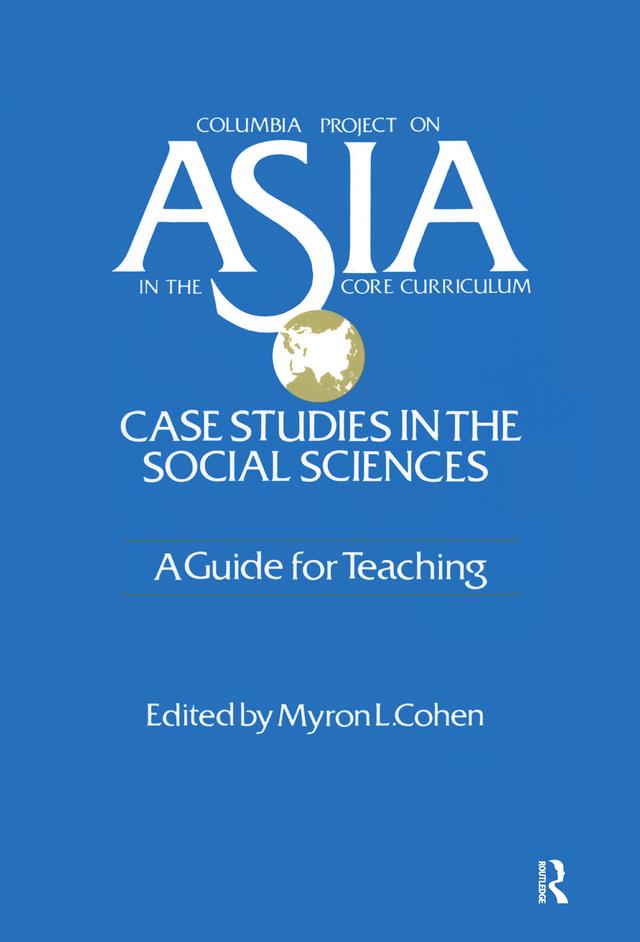
The material in this study is covered by Myron L. Cohen on religion and family organization in China; John R. Bowen on family, kinship, and Islam in Indonesia; Robert W. Hefner on hierarchy and stratification in Java; and Nancy Rosenberger on gender roles in Japan. Further material is provided by William W. Kelly on rural society in Japan; Theodore C. Bestor on urban life in Japan; Stephen R. Smith on the family in Japan; Doranne Jacobson on gender relations in India; Lawrence A. Babb on religion in India; Owen M. Lynch on stratification, inequality, and the caste system in India; Laurell Kendall on changing gender relations in Korea; Andrew G. Walder on comparative revolution in China and Vietnam, Maoism, and the sociology of work in China and Japan; Moni Nag on the comparative demography of China, Japan, and India; and Helen Hardacre on the new religions of Japan. Other contributors offering information through case studies are Hiroshi Ishida on stratification and mobility in Japan; Robert C. Liebman on work and education compared in Japan and the US; Joseph W. Elder on education, urban society, urban problems, and industrial society in India; Andrew J. Nathan on totalitarianism, authoritarianism, and democracy in China; Jean C. Oi on mobilisation and participation in China; Edwin A. Winckler on political development in Taiwan; Carl H. Lande on political parties and representation in the Philippines ; Clark N. Neher on political development and political participation in Thailand; and Benedict R. O'G. Anderson on political culture, the military, and authoritarianism in Indonesia. The final chapters of this work include studies by Stephen Philip Cohen on the military in India and Pakistan; Paul R. Brass on democracy and political participation in India; T.J. Pempel on Japanese democracy and political culture, political parties and representation, and bureaucracy in Japan; Han-kyo Kim on political development in South Korea; and Thomas G. Rawski on the economies of China and Japan.
Zahle einfach mit Karte, Klarna, Apple Pay oder Google Pay. Nicht zufrieden? Du hast immer ein 14-tägiges Widerrufsrecht. Lies mehr in unseren AGB. Hast du Fragen, schreib uns eine E-Mail an hello@memmo.org.
Memmo macht das Lernen einfacher – wo auch immer du bist. Bei uns findest du deine Kursbücher und smarte Lerntools an einem Ort: Zusammenfassungen, Quizzes, Podcasts und Lernkarten. Und Ted, dein Lernbuddy, beantwortet alles, was du wissen möchtest. Über 50.000 Studierende lernen bereits hier – gemacht, damit du schneller lernst und weniger Stress hast.
Das könnte dir auch gefallen
Buch kaufen0