
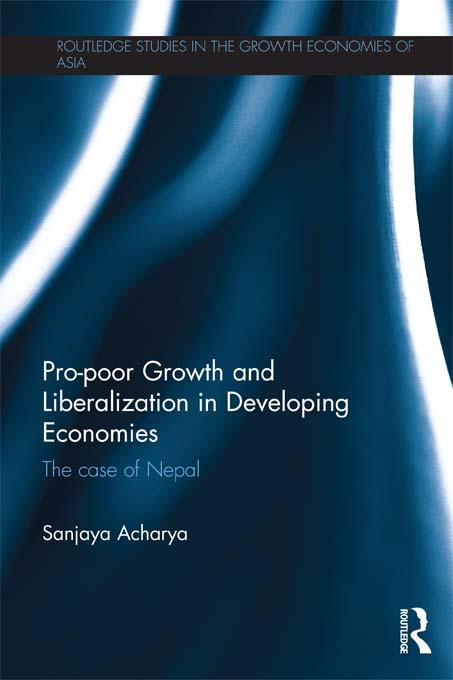
By looking at the link between trade liberalization and pro-poor growth in Nepal, this book explores how a developing and transition economy can attain higher and pro-poor growth along with the ongoing trend of globalization. The author develops a social accounting database for Nepal and applies it to quantify computable general equilibrium (CGE) model to investigate the trade-offs between growth and distribution that are associated with opening up the economy and deregulating it.
The book presents a number of pragmatic scenarios that bring about the desired pro-poor growth effects in order to demonstrate possible outcomes for policy making. The research findings apply to other economies with similar macroeconomic structure to Nepal; those small economies with a dominant, traditional, and stagnant agriculture; fragile industrial base, weak and volatile external sector, and almost half of the population living below the poverty line. This book will be of considerable interest to students and scholars in the areas of development economics, political economy of policy reforms, and trade and poverty with special emphasis on South Asia.
Zahle einfach mit Karte, Klarna, Apple Pay oder Google Pay. Nicht zufrieden? Du hast immer ein 14-tägiges Widerrufsrecht. Lies mehr in unseren AGB. Hast du Fragen, schreib uns eine E-Mail an hello@memmo.org.
Memmo macht das Lernen einfacher – wo auch immer du bist. Bei uns findest du deine Kursbücher und smarte Lerntools an einem Ort: Zusammenfassungen, Quizzes, Podcasts und Lernkarten. Und Ted, dein Lernbuddy, beantwortet alles, was du wissen möchtest. Über 50.000 Studierende lernen bereits hier – gemacht, damit du schneller lernst und weniger Stress hast.