
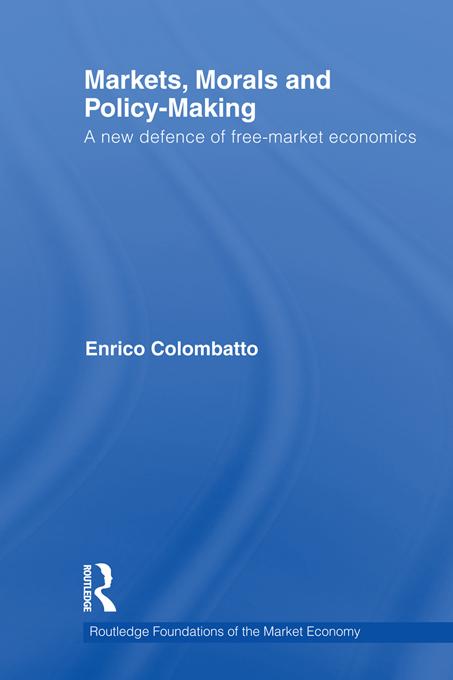
Free-market economics has attempted to combine efficiency and freedom by emphasizing the need for neutral rules and meta-rules. These efforts have only been partly successful, for they have failed to address the deeper, normative arguments justifying – and limiting – coercion. This failure has thus left most advocates of free-market vulnerable to formulae which either emphasize expediency or which rely upon optimal social engineering to foster different notions of the common will and of the common good. This book offers the reader a new perspective on free-market economics, one in which the defense of markets is no longer based upon the utilitarian claim that free markets are more efficient; rather, the defense of markets rests upon the moral argument that top-down coercive policy-making is necessarily in tension with the rights-based notion of justice typical of the Western tradition.
In arguing for a consistent moral basis for the free-market view, we depart from both the Austrian and neoclassical traditions by acknowledging that rationality is not a satisfactory starting point. This rejection of rationality as the complete motivator for human economic behaviour throws constitutional economics and the law-and-economics tradition into new relief, revealing these approaches as governed by considerations derived by various notions of social efficiency, rather than by principles consistent with individual freedom, including freedom to choose.
This book shows that the solution is in fact a better understanding of the lessons taught by the Scottish Enlightenment: the role of the political context is to ensure that the individual can pursue his own ends, free from coercion. This also implies individual responsibility, respect for somebody else’s preferences and for his entrepreneurial instincts. Social virtue is not absent from this understanding of politics, but rather than being defined through the priorities of policy-makers, it emerges as the outcome of interaction among self-determining individuals. The strongest and most consistent case for free-market economics, therefore, rests on moral philosophy, not on some version of static-efficiency theorizing.
This book should be of interest to students and researchers focussing on economic theory, political economics and the philosophy of economic thought, but is also written in a non-technical style making it accessible to an audience of non-economists.
Zahle einfach mit Karte, Klarna, Apple Pay oder Google Pay. Nicht zufrieden? Du hast immer ein 14-tägiges Widerrufsrecht. Lies mehr in unseren AGB. Hast du Fragen, schreib uns eine E-Mail an hello@memmo.org.
Memmo macht das Lernen einfacher – wo auch immer du bist. Bei uns findest du deine Kursbücher und smarte Lerntools an einem Ort: Zusammenfassungen, Quizzes, Podcasts und Lernkarten. Und Ted, dein Lernbuddy, beantwortet alles, was du wissen möchtest. Über 50.000 Studierende lernen bereits hier – gemacht, damit du schneller lernst und weniger Stress hast.