
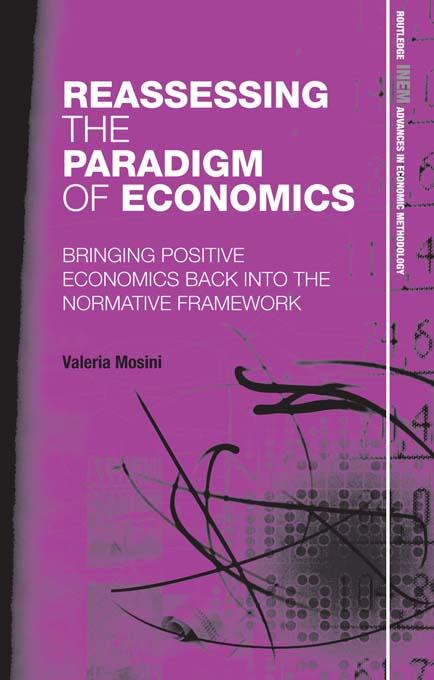
When President Reagan and Prime Minister Thatcher adopted the neoliberal doctrine as the paradigm of economics, there was no evidence that the move would have been successful, but thirty years on, the recurrent crises that culminated in 2008 suggest a serious mis-match between expectations and outcomes: a re-examination of the paradigm is in order. This book focuses on Milton Friedman’s formulation of the neoliberal doctrine, and analyses two aspects that were essential to turning it into a fully-fledged paradigm: the attribution of scientific status to positive economics, which led to informing public policies on the requirements of the market; and the characterisation of economic freedom as capable of promoting political freedom, which led to identifying free market with democracy.
The book exposes Friedman’s methodological argument for attributing positive economics scientific status as a failure, and his characterisation of economic freedom as a delusion; it identifies in the emergence as the mainstream in economics of the neoclassical synthesis, which borrowed from Walras’ the mathematical treatment of equilibrium but not the ethical and social framework in which it was inscribed, a development that facilitated the transition from the Keynesian to the neoliberal paradigm.
Dr. Mosini shows that the gigantic bail-outs carried out courtesy of the public purse, which institutionalised the practice of collectivising losses while keeping profits private, were no accident, but the consequence of the rethinking of the function of lender of last resort according to Friedman’s conception of rationality in relation to risk, combined with his interpretation of the 1930s recession. The book concludes that the neoliberal paradigm has served the interests of the economically powerful social strata it was designed to benefit extremely well, but that the deep, and deepening, injustice it has brought about calls for a complete rethinking of the paradigm of economics according to ethical principles respectful of human values. This book should be of interest to students and researchers of Political Economy, Economic Methodology, History of Economic Thought and Philosophy.
Zahle einfach mit Karte, Klarna, Apple Pay oder Google Pay. Nicht zufrieden? Du hast immer ein 14-tägiges Widerrufsrecht. Lies mehr in unseren AGB. Hast du Fragen, schreib uns eine E-Mail an hello@memmo.org.
Memmo macht das Lernen einfacher – wo auch immer du bist. Bei uns findest du deine Kursbücher und smarte Lerntools an einem Ort: Zusammenfassungen, Quizzes, Podcasts und Lernkarten. Und Ted, dein Lernbuddy, beantwortet alles, was du wissen möchtest. Über 50.000 Studierende lernen bereits hier – gemacht, damit du schneller lernst und weniger Stress hast.