
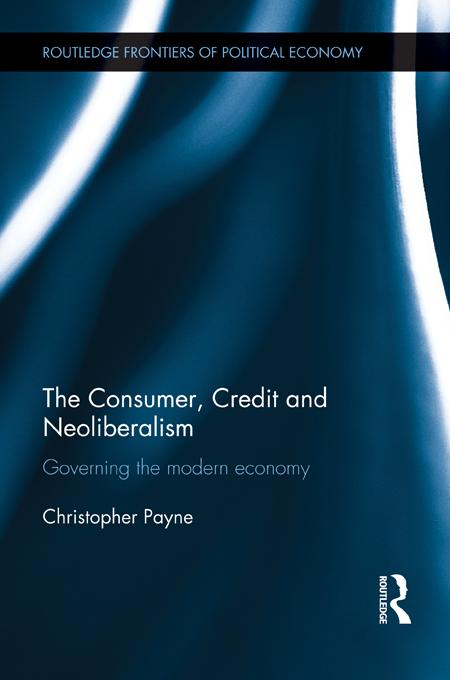
This book is an investigation into the economic policy formulation and practice of neoliberalism in Britain from the 1950s through to the financial crisis and economic downturn that began in 2007-8. It demonstrates that influential economists, such as F.A. Hayek and Milton Friedman, authors at key British think tanks such as the Institute of Economic Affairs and the Centre for Policy Studies, and important political figures of the Thatcher and New Labour governments shared a similar conception of the consumer.
For neoliberals, the idea that consumers were weak in the face of businesses and large corporations was almost offensive. Instead, consumers were imagined to be sovereign agents in the economy, whose consumption decisions played a central role in the construction of their human capital and in the enabling of their aspirations. Consumption, just like production, came to be viewed as an enterprising and entrepreneurial activity. Consequently, from the early 1980s until the present day, it was felt necessary that banks should have the freedom to meet the borrowing needs of consumers. Credit rationing would be a thing of the past. Just like businesses, consumers and households could use debt to expand their stock of personal assets.
By utilizing the method of French philosopher Michel Foucault this book provides an original analysis of the policy ideas and political speeches of key figures in the New Right, in government and at the Bank of England. And it addresses the key question as to why policy-makers both in Britain and the United States did little or nothing to stem rising consumer and household indebtedness, instead always choosing to see increasing house prices and homeownership as a positive to be encouraged.
Zahle einfach mit Karte, Klarna, Apple Pay oder Google Pay. Nicht zufrieden? Du hast immer ein 14-tägiges Widerrufsrecht. Lies mehr in unseren AGB. Hast du Fragen, schreib uns eine E-Mail an hello@memmo.org.
Memmo macht das Lernen einfacher – wo auch immer du bist. Bei uns findest du deine Kursbücher und smarte Lerntools an einem Ort: Zusammenfassungen, Quizzes, Podcasts und Lernkarten. Und Ted, dein Lernbuddy, beantwortet alles, was du wissen möchtest. Über 50.000 Studierende lernen bereits hier – gemacht, damit du schneller lernst und weniger Stress hast.