
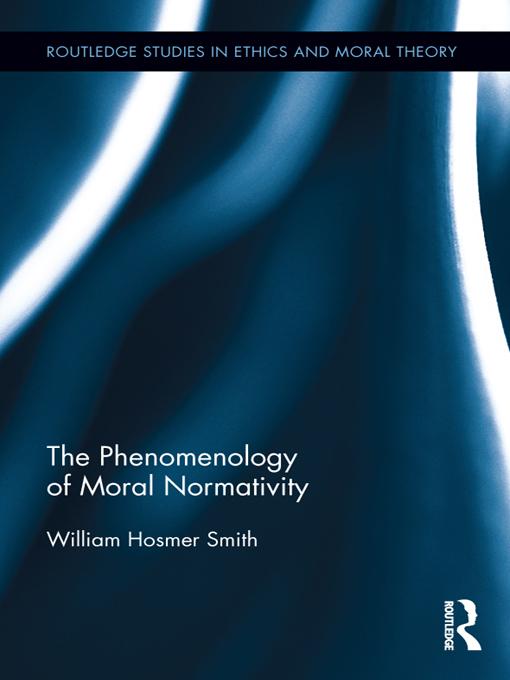
Why should I be moral? Philosophers have long been concerned with the legitimacy of morality’s claim on us—especially its ostensible aim to motivate certain actions of all persons unconditionally. This problem of moral normativity has received extensive treatment in analytic moral theory, but little attention has been paid to the potential contribution that phenomenology might make to this central debate in metaethics.
In The Phenomenology of Moral Normativity, William H. Smith takes up the question of morality’s legitimacy anew, drawing contemporary moral philosophers into conversation with the phenomenological philosophy of Husserl, Heidegger, and Levinas. Utilizing a two-part account of moral normativity, Smith contends that the ground of morality itself is second-personal—rooted in the ethical demand intrinsic to other persons —while the ground for particular moral-obligations is first-personal—rooted in the subject’s avowal or endorsement of certain moral norms within a concrete historical situation.
Thus, Smith argues, phenomenological analysis allows us to make sense of an idea that has long held intuitive appeal, but that modern moral philosophy has been unable to render satisfactorily: namely, that the normative source of valid moral claims is simply other persons and what we owe to them.
Zahle einfach mit Karte, Klarna, Apple Pay oder Google Pay. Nicht zufrieden? Du hast immer ein 14-tägiges Widerrufsrecht. Lies mehr in unseren AGB. Hast du Fragen, schreib uns eine E-Mail an hello@memmo.org.
Memmo macht das Lernen einfacher – wo auch immer du bist. Bei uns findest du deine Kursbücher und smarte Lerntools an einem Ort: Zusammenfassungen, Quizzes, Podcasts und Lernkarten. Und Ted, dein Lernbuddy, beantwortet alles, was du wissen möchtest. Über 50.000 Studierende lernen bereits hier – gemacht, damit du schneller lernst und weniger Stress hast.