
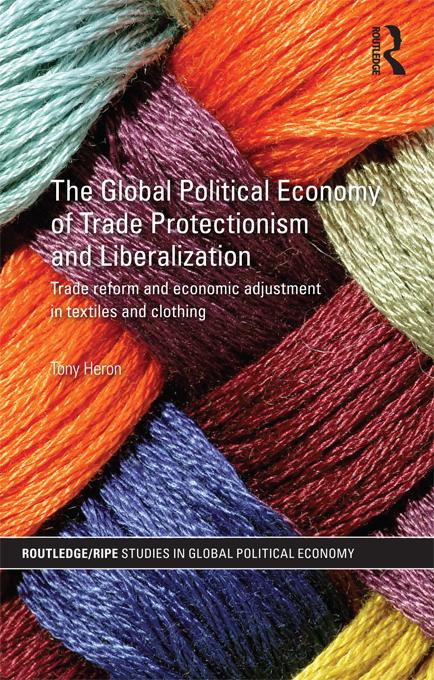
Given the widely-accepted premise that free trade is the best means of maximising overall societal welfare, why has it proven so difficult to achieve in certain industries? This book tackles arguably the most perennial and deep-rooted of all questions in political economy, and questions the incumbent orthodox liberal theories of collective action.
Using a historical institutionalist framework to explore and explain the political economy of trade protectionism and liberalization, this book is based on detailed case studies of the textiles and clothing sector in the EU, United States, China, Caribbean Basin and sub-Saharan Africa. From this, the book expands to discuss the origins of trade protectionism and examine the wider political effects of liberalization, offering an explanation of why a successful conclusion to the WTO ‘Doha’ round has proven to be so elusive. The book argues that the regulation of global trade - and the economic consequences that this has for both developed and developing countries - has been the result of the particular way in which trade preferences are mediated through political institutions.
The Global Political Economy of Trade Protectionism and Liberalization will be of interest to those studying and researching international and comparative political economy, developing area studies, economics, law and geography.
Zahle einfach mit Karte, Klarna, Apple Pay oder Google Pay. Nicht zufrieden? Du hast immer ein 14-tägiges Widerrufsrecht. Lies mehr in unseren AGB. Hast du Fragen, schreib uns eine E-Mail an hello@memmo.org.
Memmo macht das Lernen einfacher – wo auch immer du bist. Bei uns findest du deine Kursbücher und smarte Lerntools an einem Ort: Zusammenfassungen, Quizzes, Podcasts und Lernkarten. Und Ted, dein Lernbuddy, beantwortet alles, was du wissen möchtest. Über 50.000 Studierende lernen bereits hier – gemacht, damit du schneller lernst und weniger Stress hast.