
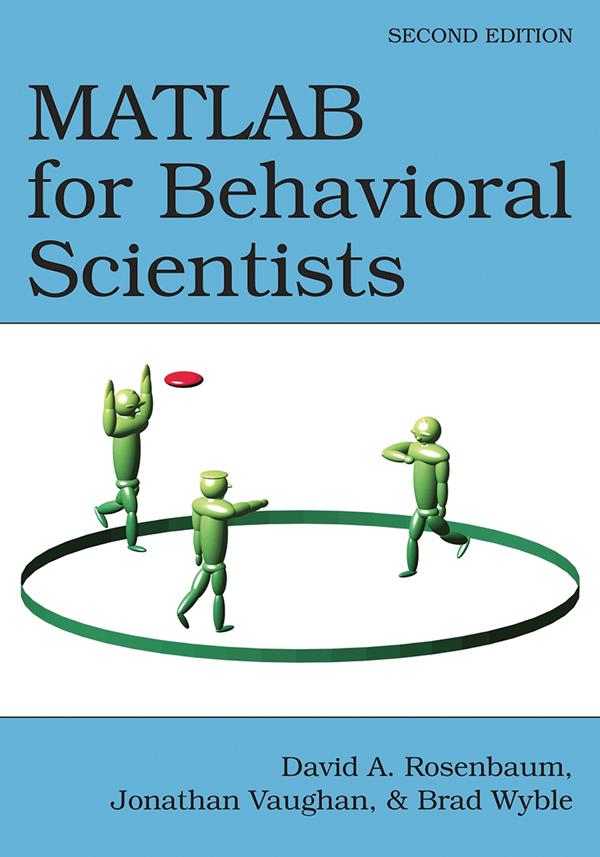
Written specifically for those with no prior programming experience and minimal quantitative training, this accessible text walks behavioral science students and researchers through the process of programming using MATLAB. The book explores examples, terms, and programming needs relevant to those in the behavioral sciences and helps readers perform virtually any computational function in solving their research problems. Principles are illustrated with usable code. Each chapter opens with a list of objectives followed by new commands required to accomplish those goals. These objectives also serve as a reference to help readers easily relocate a section of interest. Sample code and output and chapter problems demonstrate how to write a program and explore a model so readers can see the results obtained using different equations and values. A web site provides solutions to selected problems and the book’s program code output and examples so readers can manipulate them as needed. The outputs on the website have color, motion, and sound.
Highlights of the new edition include:
•Updated to reflect changes in the most recent version of MATLAB, including special tricks and new functions.
•More information on debugging and common errors and more basic problems in the rudiments of MATLAB to help novice users get up and running more quickly.
•A new chapter on Psychtoolbox, a suite of programs specifically geared to behavioral science research.
•A new chapter on Graphical User Interfaces (GUIs) for user-friendly communication.
•Increased emphasis on pre-allocation of memory, recursion, handles, and matrix algebra operators.
The book opens with an overview of what is to come and tips on how to write clear programs followed by pointers for interacting with MATLAB, including its commands and how to read error messages. The matrices chapter reviews how to store and access data. Chapter 4 examines how to carry out calculations followed by a review of how to perform various actions depending on the conditions. The chapter on input and output demonstrates how to design programs to create dialogs with users (e.g., participants in studies) and read and write data to and from external files. Chapter 7 reviews the data types available in MATLAB. Readers learn how to write a program as a stand-alone module in Chapter 8. In Chapters 9 and 10 readers learn how to create line and bar graphs or reshape images. Readers learn how to create animations and sounds in Chapter 11. The book concludes with tips on how to use MATLAB with applications such as GUIs and Psychtoolbox.
Intended as a primary text for Matlab courses for advanced undergraduate and/or graduate students in experimental and cognitive psychology and/or neuroscience as well as a supplementary text for labs in data (statistical) analysis, research methods, and computational modeling (programming), the book also appeals to individual researchers in these disciplines who wish to get up and running in MATLAB.
Zahle einfach mit Karte, Klarna, Apple Pay oder Google Pay. Nicht zufrieden? Du hast immer ein 14-tägiges Widerrufsrecht. Lies mehr in unseren AGB. Hast du Fragen, schreib uns eine E-Mail an hello@memmo.org.
Memmo macht das Lernen einfacher – wo auch immer du bist. Bei uns findest du deine Kursbücher und smarte Lerntools an einem Ort: Zusammenfassungen, Quizzes, Podcasts und Lernkarten. Und Ted, dein Lernbuddy, beantwortet alles, was du wissen möchtest. Über 50.000 Studierende lernen bereits hier – gemacht, damit du schneller lernst und weniger Stress hast.