
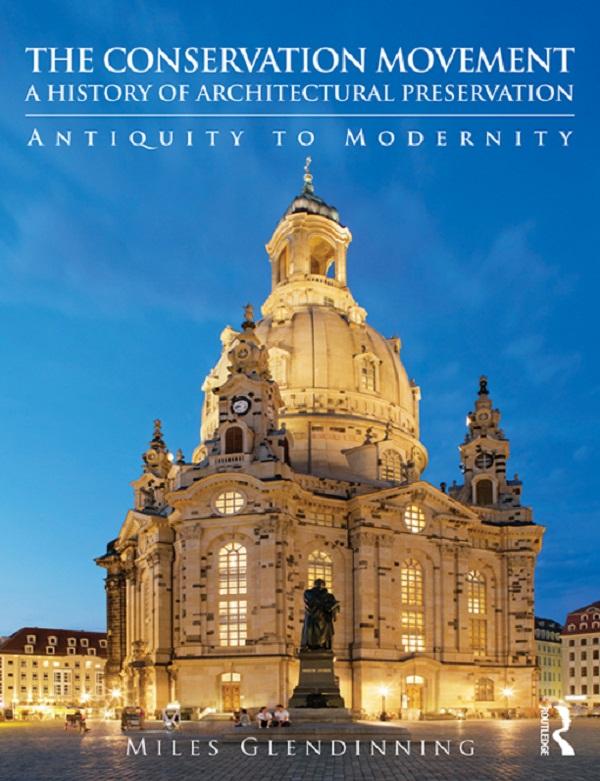
Winner of the 2016 Antoinette Forrester Downing Award presented by the Society of Architectural Historians.
In many cities across the world, particularly in Europe, old buildings form a prominent part of the built environment, and we often take it for granted that their contribution is intrinsically positive. How has that widely-shared belief come about, and is its continued general acceptance inevitable?
Certainly, ancient structures have long been treated with care and reverence in many societies, including classical Rome and Greece. But only in modern Europe and America, in the last two centuries, has this care been elaborated and energised into a forceful, dynamic ideology: a ‘Conservation Movement’, infused with a sense of historical destiny and loss, that paradoxically shared many of the characteristics of Enlightenment modernity. The close inter-relationship between conservation and modern civilisation was most dramatically heightened in periods of war or social upheaval, beginning with the French Revolution, and rising to a tragic climax in the 20th-century age of totalitarian extremism; more recently the troubled relationship of ‘heritage’ and global commercialism has become dominant.
Miles Glendinning’s new book authoritatively presents, for the first time, the entire history of this architectural Conservation Movement, and traces its dramatic fluctuations in ideas and popularity, ending by questioning whether its recent international ascendancy can last indefinitely.
Zahle einfach mit Karte, Klarna, Apple Pay oder Google Pay. Nicht zufrieden? Du hast immer ein 14-tägiges Widerrufsrecht. Lies mehr in unseren AGB. Hast du Fragen, schreib uns eine E-Mail an hello@memmo.org.
Memmo macht das Lernen einfacher – wo auch immer du bist. Bei uns findest du deine Kursbücher und smarte Lerntools an einem Ort: Zusammenfassungen, Quizzes, Podcasts und Lernkarten. Und Ted, dein Lernbuddy, beantwortet alles, was du wissen möchtest. Über 50.000 Studierende lernen bereits hier – gemacht, damit du schneller lernst und weniger Stress hast.