
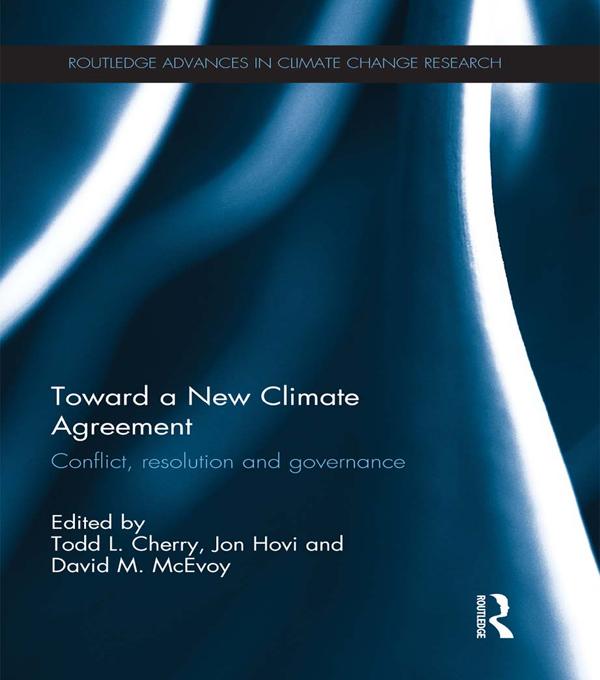
Climate change is one of the most pressing problems facing the global community. Although most states agree that climate change is occurring and is at least partly the result of humans’ reliance on fossil fuels, managing a changing global climate is a formidable challenge. Underlying this challenge is the fact that states are sovereign, governed by their own laws and regulations. Sovereignty requires that states address global problems such as climate change on a voluntary basis, by negotiating international agreements. Despite a consensus on the need for global action, many questions remain concerning how a meaningful international climate agreement can be realized.
This book brings together leading experts to speak to such questions and to offer promising ideas for the path toward a new climate agreement. Organized in three main parts, it examines the potential for meaningful climate cooperation. Part 1 explores sources of conflict that lead to barriers to an effective climate agreement. Part 2 investigates how different processes influence states’ prospects of resolving their differences and of reaching a climate agreement that is more effective than the current Kyoto Protocol. Finally, part 3 focuses on governance issues, including lessons learned from existing institutional structures.
The book is unique in that it brings together the voices of experts from many disciplines, such as economics, political science, international law, and natural science. The authors are academics, practitioners, consultants and advisors. Contributions draw on a variety of methods, and include both theoretical and empirical studies. The book should be of interest to scholars and graduate students in the fields of economics, political science, environmental law, natural resources, earth sciences, sustainability, and many others. It is directly relevant for policy makers, stakeholders and climate change negotiators, offering insights into the role of uncertainty, fairness, policy linkage, burden sharing and alternative institutional designs.
Zahle einfach mit Karte, Klarna, Apple Pay oder Google Pay. Nicht zufrieden? Du hast immer ein 14-tägiges Widerrufsrecht. Lies mehr in unseren AGB. Hast du Fragen, schreib uns eine E-Mail an hello@memmo.org.
Memmo macht das Lernen einfacher – wo auch immer du bist. Bei uns findest du deine Kursbücher und smarte Lerntools an einem Ort: Zusammenfassungen, Quizzes, Podcasts und Lernkarten. Und Ted, dein Lernbuddy, beantwortet alles, was du wissen möchtest. Über 50.000 Studierende lernen bereits hier – gemacht, damit du schneller lernst und weniger Stress hast.