
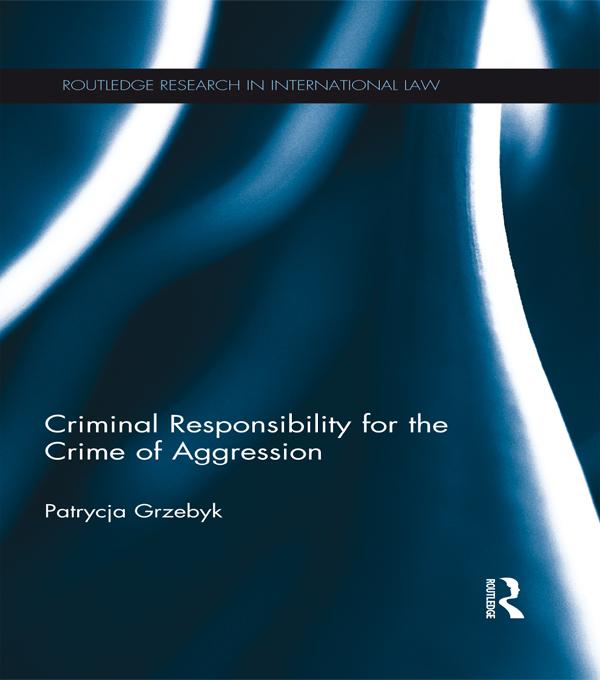
Since the Nuremberg trial, the crime of aggression has been considered one of the gravest international crimes. However, since the 1940s no defendants have been charged with this crime, with some states actively opposing the notion of punishing aggression. The option of trying an individual for aggression is expressly included in the statute of the International Criminal Court. In 2010 the Assembly of States Parties adopted a definition of the crime of aggression and conditions of the exercise of jurisdiction over this crime by the Court. The Assembly also agreed that the decision on including the crime of aggression within the Court’s jurisdiction would be made in 2017 at the earliest. It is still internationally debatable whether the criminalisation of aggression is an outcome to strive for, or whether its abandonment is more preferable.
In Criminal Responsibility for the Crime of Aggression, Patrycja Grzebyk explores the scope of criminal responsibility of individuals for crimes of aggression and asks why those responsible for aggression are not brought to justice. The book first works to identify the legal norms that define and delegalise aggression, before moving to determine the basis and scope for the criminalisation of aggression. The book then goes on to identify the key risks and difficulties inherent in trials for aggression.
Following a string of awards in Poland, including the Manfred Lachs Prize for the best first book on public international law, this cutting investigation of aggression is now deservedly made available to the wider world. In its extensive analysis of international trials on aggression, and its synthesis of legal, political and historical rhetoric, this book offers broad and striking insight into the criminal responsibility of individuals on a world stage.
Zahle einfach mit Karte, Klarna, Apple Pay oder Google Pay. Nicht zufrieden? Du hast immer ein 14-tägiges Widerrufsrecht. Lies mehr in unseren AGB. Hast du Fragen, schreib uns eine E-Mail an hello@memmo.org.
Memmo macht das Lernen einfacher – wo auch immer du bist. Bei uns findest du deine Kursbücher und smarte Lerntools an einem Ort: Zusammenfassungen, Quizzes, Podcasts und Lernkarten. Und Ted, dein Lernbuddy, beantwortet alles, was du wissen möchtest. Über 50.000 Studierende lernen bereits hier – gemacht, damit du schneller lernst und weniger Stress hast.