
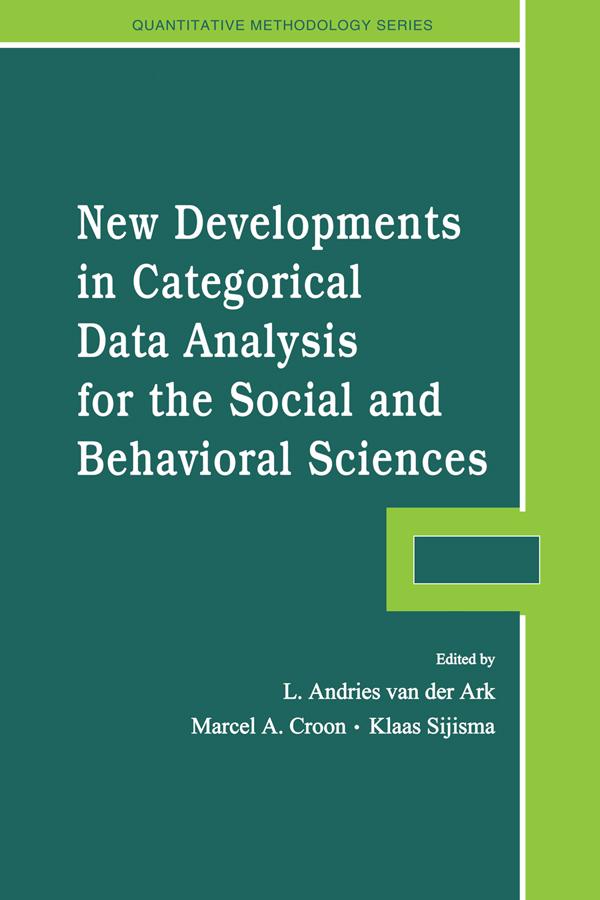
Categorical data are quantified as either nominal variables--distinguishing different groups, for example, based on socio-economic status, education, and political persuasion--or ordinal variables--distinguishing levels of interest, such as the preferred politician or the preferred type of punishment for committing burglary. This new book is a collection of up-to-date studies on modern categorical data analysis methods, emphasizing their application to relevant and interesting data sets.
This volume concentrates on latent class analysis and item response theory. These methods use latent variables to explain the relationships among observed categorical variables. Latent class analysis yields the classification of a group of respondents according to their pattern of scores on the categorical variables. This provides insight into the mechanisms producing the data and allows the estimation of factor structures and regression models conditional on the latent class structure. Item response theory leads to the identification of one or more ordinal or interval scales. In psychological and educational testing these scales are used for individual measurement of abilities and personality traits.
The focus of this volume is applied. After a method is explained, the potential of the method for analyzing categorical data is illustrated by means of a real data example to show how it can be used effectively for solving a real data problem. These methods are accessible to researchers not trained explicitly in applied statistics. This volume appeals to researchers and advanced students in the social and behavioral sciences, including social, developmental, organizational, clinical and health psychologists, sociologists, educational and marketing researchers, and political scientists. In addition, it is of interest to those who collect data on categorical variables and are faced with the problem of how to analyze such variables--among themselves or in relation to metric variables.
Zahle einfach mit Karte, Klarna, Apple Pay oder Google Pay. Nicht zufrieden? Du hast immer ein 14-tägiges Widerrufsrecht. Lies mehr in unseren AGB. Hast du Fragen, schreib uns eine E-Mail an hello@memmo.org.
Memmo macht das Lernen einfacher – wo auch immer du bist. Bei uns findest du deine Kursbücher und smarte Lerntools an einem Ort: Zusammenfassungen, Quizzes, Podcasts und Lernkarten. Und Ted, dein Lernbuddy, beantwortet alles, was du wissen möchtest. Über 50.000 Studierende lernen bereits hier – gemacht, damit du schneller lernst und weniger Stress hast.