
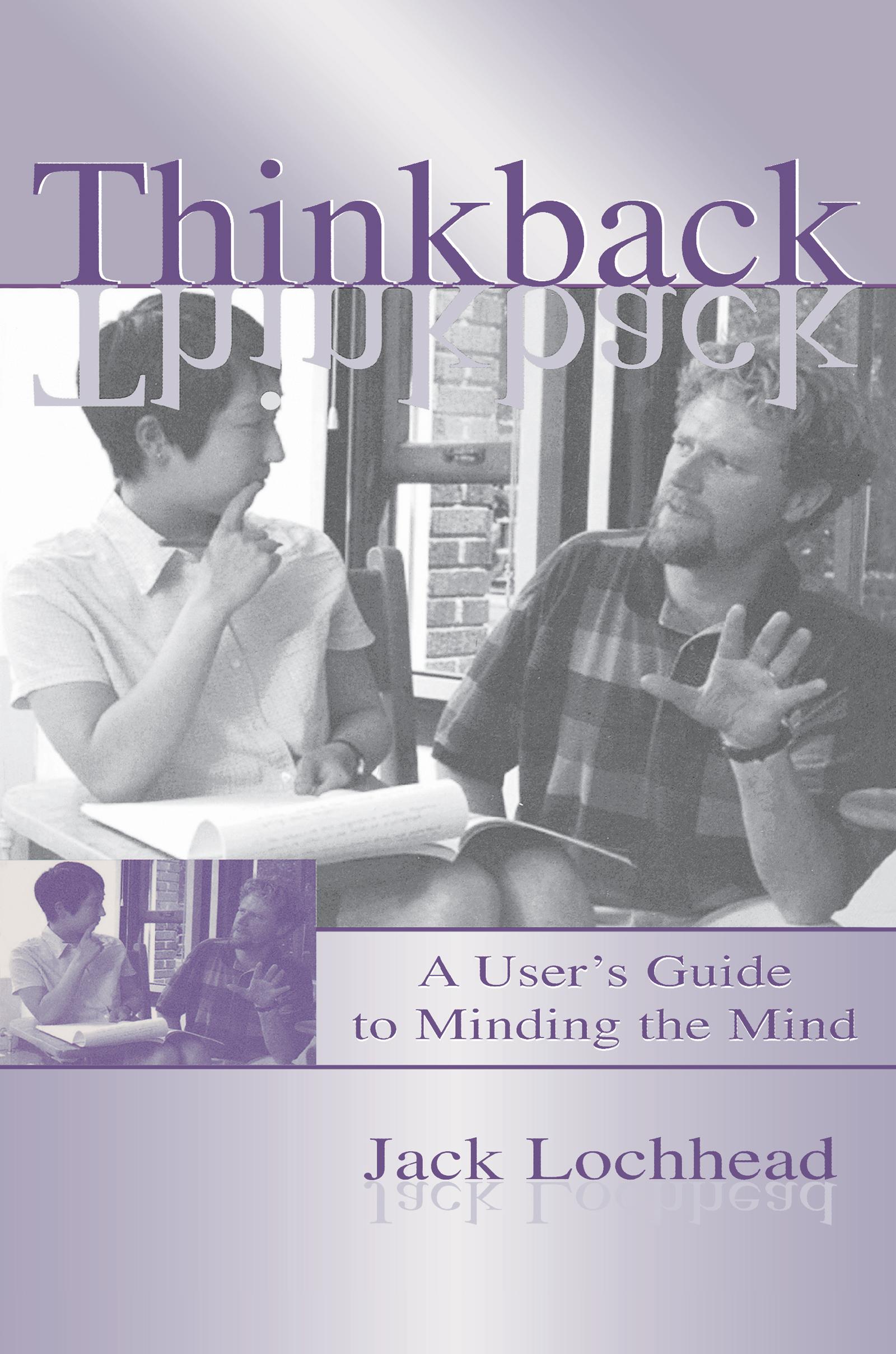
The fundamental premise of Thinkback--based on overwhelming scientific evidence--is that intelligence is not fixed at birth and that, with consistent effort, we can dramatically improve our capacities. It counters the claims of some psychologists that it is impossible to increase intelligence because that ability is determined at birth.
Thinkback builds on the Think Aloud strategies in Arthur Whimbey and Jack Lochhead's popular and widely used volume, Problem Solving & Comprehension, now in its sixth edition. Since its publication, thousands of students have used these techniques for improving thinking and analytic reasoning to increase test scores, win National Merit
Scholarships, and gain admission to top-ranked professional schools. Now, Thinkback shows how these powerful strategies can be applied to a range of important academic areas including mathematics, language arts, social studies, and science.
Thinkback is a tool for student empowerment--a strategy they can use to improve both their ability to think and their ability to learn. The Thinkback classroom, on the other hand, is a design for teacher liberation--enabling them to see learning more clearly than they ever could before.
This is the only book currently available that contains detailed models of metacognitive dialogues in the classroom. These dialogues enable teachers and teacher educators to observe thinking processes that have previously been invisible and undetectable. Based on over 20 years of careful cognitive research, the dialogues provide teachers with important insights into the nature of thinking and problem solving. Thinkback is a picture window on the working mind.
This book:
*Describes the Thinkback strategy for making thinking strategies explicit, easy to teach, and easy to learn.
*Includes numerous detailed examples that demonstrate the Thinkback technique. Six quite different learning strategies--derived from the work of David Perkins, Barry Beyer, Arthur Whimbey, Joseph Novak, John R. Hayes, and Lev Landa--are presented to illustrate the range of contexts in which Thinkback can be used.
*Spans the wide gap between unstructured constructivist-style instruction and lock-step memorization drills. The Thinkback technique can convert a teacher-centered rote memory lesson into an intellectually challenging student-centered exploration, while at the same time maintaining specific content mastery objectives. Or it can be used to add subtle structure to an open-ended creative exercise, allowing students of all levels to benefit and insuring that no one is left floundering.
Thinkback is an important new resource for teachers and students in high schools, community colleges, and introductory college programs; industrial trainers; home schoolers; parents; and anyone else who would like to see learners become more intelligent and are willing to work to see that they do.
Zahle einfach mit Karte, Klarna, Apple Pay oder Google Pay. Nicht zufrieden? Du hast immer ein 14-tägiges Widerrufsrecht. Lies mehr in unseren AGB. Hast du Fragen, schreib uns eine E-Mail an hello@memmo.org.
Memmo macht das Lernen einfacher – wo auch immer du bist. Bei uns findest du deine Kursbücher und smarte Lerntools an einem Ort: Zusammenfassungen, Quizzes, Podcasts und Lernkarten. Und Ted, dein Lernbuddy, beantwortet alles, was du wissen möchtest. Über 50.000 Studierende lernen bereits hier – gemacht, damit du schneller lernst und weniger Stress hast.